In the late 1960s and early 70s British anthropologist Mary Douglas (1921-2007) established a new way of interpreting social life. First known as ‘grid-group’ theory’, it has attracted several different names over the decades, including, on Wikipedia, the cultural theory of risk.
This site attempts to view the social world of today through the lens of this well-established cultural theory. People are strange and organizations even stranger. Cultural theory offers a useful framework to consider why people in groups might behave the way they do.
First setting out her theory in Natural Symbols: Explorations in Cosmology (1970), Mary Douglas identified four cultural biases, ‘thought styles’, or worldviews. They contradict one another, but also define themselves in distinction to the others. In this way, each of the four cultures depends on the other three for its viability. As one study of Douglas’s work puts it:
“there are four sides to every question.”
Richards, Paul, and Perri 6. Mary Douglas. Anthropology’s Ancestors, Volume 4. New York: Berghahn Books, 2023.
The name of this site, Four Cultures, refers to a short article in which Douglas introduced her social theory and discussed its development over three decades:
Douglas, M. 1999. Four cultures: The evolution of a parsimonious model. GeoJournal 47:411–415. DOI: 10.1023/A:1007008025151
Since the early days, many researchers in numerous areas of study have used, adapted and extended the four cultures framework to apply to a wide variety of social contexts. As her biographer Richard Farndon observed, “the scholarship of Mary Douglas has achieved wide-ranging interdisciplinary recognition” (and you can hear Professor Farndon talking about the significance of Mary Douglas’s work in a British Academy podcast).
The aim of this site is to make a tiny contribution to furthering the recognition of Mary Douglas’s cultural theory, and of the work it has inspired. You can find resources here as well as longer articles and shorter notes. Thanks for dropping by.
“Our ultimate task is to find interpretative procedures that will uncover each bias and discredit its claims to universality.”
Mary Douglas and B. Isherwood (1979). The World of Goods: Towards an Anthropology of Consumption. London, Allen Lane, page 63
Frantz Fanon, psychiatrist, writer and anti-colonialist
Frantz Fanon has much to teach about the power of new media.
Technology in transition
During the COVID-19 lockdown everyone I know was using their webcam to meet via video-conference. Or not.
Many had poor Internet access, and others wanted to resist yet another attempt to steal their privacy. For some the pandemic opened a new era of ‘working from home’ and made video conferencing normal. For others, the jump to Zoom, Teams and the like just widened the gap between tech insiders and outsiders.
This situation of rapid change got me thinking about the complex ways in which adoption of new technology impacts society.
The drive to do so much more online in 2020 is having very significant impacts in the longer term – both for the participants and for those excluded. We’ve crossed a transition point, where technological adoption is accelerating beyond our collective capacity to grasp the implications.
Such transitions have happened many times before, and one of the more recent shifts took place in the early 2010s. There has been plenty of interest in the role of social media in that series of revolutions known as the Arab Spring (2010-2012). It was a time when reformist values seemed to travel extremely rapidly via the mobile phones that had become ubiquitous in the Middle East, and everywhere else. But the focus on the role of media in times of rapid social change goes back a long way. In the Arab world, the Algerian War of the 1950s was a key period for understanding the ways the media influence the course of history.
Radio and Independence
A key text is Frantz Fanon’s essay, This is the Voice of Algeria. Fanon wrote about the changing understanding of radio in colonial Algeria during the 1950s.
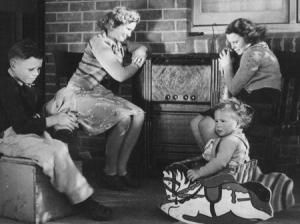
At first the indigenous Algerian population saw the radio as a foreign entity, destructive of traditional family relationships. Back in France, the image of a family gathering around the wireless set at night was a cosy, socially reinforcing one. But in Algeria it was widely seen as socially suspect, because it threatened to mix genders and ages in non-traditional ways. To overcome this the French colonial broadcaster identified certain radio programmes as particularly suitable for family listening.
This strategy did not work.
In the population at large radios were neither bought nor listened to. Meanwhile the radio diffused news of unrest to the colonial farmers. For them, the radio was a voice of security and normality, “the only way to still feel like a civilized man”. It was a bulwark, Fanon claims, against ‘going native’.
The wireless: a cosy, socially reinforcing image?
Ironically, the European farmers would hear the news then gather their workers to celebrate victories against an insurgency of which the workers, being without radios themselves, would otherwise have known nothing.
Fanon’s argument is that the classic sociological rationale for a lack of radio listening among Algerians was ‘a mass of errors’. The standard line was that “Traditions of respectability are so important for us and are so hierarchical, that it is practically impossible for us to listen to radio programs in the family”. Fanon’s gloss on this is:
“Here, then, at a certain explicit level, is the apprehension of a fact: receiving sets are not readily adopted by Algerian society. By and large, it refuses this technique which threatens its stability and the traditional types of sociability; the reason invoked being that the programs in Algeria, undifferentiated because they are copied from the Western model, are not adapted to the strict, almost feudal type of patrilineal hierarchy, with its many moral taboos, that characterizes the Algerian family.”
So what changed?
Contested hierarchies
Fanon claims this argument about family traditions is bogus. The evidence? As soon as a nationalist radio station appeared, it was so popular that all the radios sold out in a matter of weeks and batteries for them were almost unobtainable. If this was really a matter of traditional family values, how could these values have been abandoned so comprehensively in the space of a month or two?
Only with the start of nationalist radio broadcasts did the radio become a tool of decolonization. The French authorities strongly objected to the German supply of radios from the Telefunk company. The Germans ignored the French. So the French colonial powers jammed the unauthorised broadcasts, whereupon, according to Fanon, families would actively listen to the static and imagine the news of nationalist victories that were surely what the French were trying to suppress.
“He had to enter the vast network of news; he had to find his way in a world in which things happened, in which events existed, in which forces were active. Through the experience of a war waged by his own people, the Algerian came in contact with an active community. The Algerian found himself having to oppose the enemy news with his own news.”
One interpretation of this version of history is that the real hierarchical distinction the radio emphasized was not between traditional family relations such as man and woman, father and child. There was, to be sure, Fanon pointed out, hierarchy in Algerian society, but it was first and foremost between colonizers and colonized, between the oppressor and the oppressed. This dominant hierarchical relationship was actually what the new technology foregrounded and made even more problematic.
Another interpretation of this situation might be that technology finds its own uses, as the saying goes. At first the Algerian nationalists had no need of the radio if all it could tell them was the French were in charge. They were already painfully aware of that information.
It took a while for the Algerian nationalists to realise that radio, previously the voice of the oppressor, could instead become the voice of the independence movement. Or perhaps they always recognised this but it took time to organise the resources to start broadcasting for themselves. Either way, the technology had to be re-imagined and then re-purposed in order for it to be adopted by the mass of the population for their own ends.
“With the creation of a Voice of Fighting Algeria, the Algerian was vitally committed to listening to the message, to assimilating it, and soon to acting upon it. Buying a radio, getting down on one’s knees with one’s head against the speaker, was no longer just wanting to get the news concerning the formidable experience in progress in the country, it was hearing the first words of the nation.”
Information environments: quantity or quality?
An interesting spin on this discussion comes from research investigating the much more recent uses of electronic communications in regime change during the revolutionary period known as the Arab Spring (Benkirane, 2012; Howard and Hussain, 2013).
Researchers calculated that there is a play-off between the sheer amount of information available to the population on the one hand, and its quality on the other.
A larger amount of information supports the status quo – it may well be propaganda. After all, the Nazis successfully subsidised the mass distribution of radios in the 1930s in order to promote their message. But, conversely, higher quality information supports change – telling it like it is, warts and all. It really is quality – not quantity – that matters.
This typology of information results in four ideal-type information environments. The high quantity – low quality environment benefits a repressive regime. Plenty of information is available, but it’s mostly propaganda. A high quantity, high quality information environment promotes moves for change because it becomes easy to see that the regime isn’t working.
In the light of this scheme what are we to make of Fanon’s interpretation of radio-listening?
The farmers without radios were in an environment of low information, and low quality. They knew almost nothing of what the radio was telling them and if they did listen in, it didn’t tell them anything they recognized as worth knowing. They had to resort to other media for their news.
In contrast, the Algerian family sitting around the radio listening to the static of the jamming signal were in an environment of low quantity, but curiously high quality. The jammed signal told them almost nothing, but what it did tell them was the most important thing of all: that there existed somewhere out there a signal that the colonists needed to jam. All the other details were filled in by the listeners’ imaginations.
This was not the only impact of radio on the progress of Algerian independence. In 1961, towards the end of the Algerian War, a group of hardline French nationalists took over the main centres of Algeria and attempted a coup inside France against President De Gaulle. They opposed the President because he had already established that by now the majority of both the French and Algerian populations wanted Algerian independence.
Unluckily for the plotters, the transistor radio had recently been invented and mass produced. Now the French all had portable radios. As a result, De Gaulle’s desperate and determined broadcast to the nation was heard by many, many people. This was to some extent an accident, since de Gaulle actually appeared on television, although TV sets were not yet widely distributed. In particular, army conscripts who were not part of the coup heard it on their new portable radios. This was determinative for what became known as ‘the battle of the transistors’.
The coup ultimately failed, because the radio enabled De Gaulle to connect directly with soldiers of all ranks and with the wider French population. He didn’t need to say much for his message to be understood. It was low-quantity, but extremely high quality.
The President’s key message comes in the final three seconds of a historic twenty-minute speech:
“Aidez-moi!”
Perhaps you will be able to consider these four quadrants of information when you next devise your important message. High and low quantity; high and low quality. If you want things to stay the same, your best strategy is to flood the channels with quantity. Sit-coms, soap operas, adverts, shock-jock phone-ins. It’s all endlessly the same and this is its essential value. There is only one real message in this mass of repetitive material: things are the same today as they were yesterday. And tomorrow the same power-holders will be gripping it even more tightly.
Remember, though, that those seeking change will keep on looking for the quality of information they need until they find it.
See also:
Baucom, Ian. 2001. “Frantz Fanon’s Radio: Solidarity, Diaspora, and the Tactics of Listening.”Contemporary Literature42 (1): 15. https://doi.org/10.2307/1209083.
Benkirane, Reda. 2016. “The Alchemy of Revolution: The Role of Social Networks and New Media in the Arab Spring.” GCSP Policy Paper 7, no. 1.
Fanon, Frantz. 2016. This is the Voice of Algeria. In: Fanon, F. (ed.), A Dying Colonialism, trans. H. Chevalier. New York: Grove Press.
Gibson, Nigel C. 2003. Fanon: The Postcolonial Imagination. Key Contemporary Thinkers. Cambridge, U.K. : Malden, MA: Polity Press in association with Blackwell Pub
Howard, Philip N., and Muzammil M. Hussain. 2013. Democracy’s fourth wave?: digital media and the Arab Spring. Oxford University Press.
Stevens, Anne. 2016. The Government and Politics of France. London: Macmillan Education, Limited. (On the ‘battle of the transistors’ see p.80).
Here’s a photo taken a while ago that never made it into a post. It’s an advert I saw on a bus shelter. It isn’t the clearest photo in the world, but it tells a story. The story it tells is very clearly expressed by the sociologist Zygmunt Bauman. It shows that in our society, being an individual is a task we’re assigned. We have to work hard at it. For example, there are things to buy. Buying things also bought by others is the surest way to achieve individuality. The irony, according to Bauman, is that individuality – the mandate of the society of individuals – is thus impossible to achieve. The quotations below are from Chapter 1 of Bauman, Z. (2005). Liquid Life. Cambridge : Polity 15-38.
Individuality is a task set for its members by the society of individuals – set as an individual task, to be individually performed, by individuals using their individual resources. Yet such a task is self-contradictory and self -defeating : indeed, impossible to fulfil.
(2005:18)
When it is serviced by the consumer markets, the marathon of the pursuit of individuality draws its urgency and impetus from the terror of being caught up, absorbed and devoured by the crowd of runners breathing heavily behind one’s back. But in order to join the race and to stay in it, you first need to purchase the ‘special marathon shoes ‘ which – surprise, surprise – all the rest of the runners wear or deem it their duty to obtain.
(Bauman 2005 :25)
As a task, individuality is an end product of societal transformation disguised as a personal discovery.
(2005:19; cf. 29)
There’s a good summary of Zygmunt Bauman’s Liquid Modernity – Chapter One at Realsociology.
But individuality isn’t the only kind of societal transformation that might be found disguised as a personal discovery. Communality, being part of a group, is also a kind of social demand dressed up as a personal task. There is a Japanese phrase: minna no kimochi. This means something like ‘being of one heart’. One could say: “Our feelings about the game came together and we played well”. Marie Mutsuki Mockett has written about how minna no kimochi is used to explain how political change might come to Japan after the great tsunami of 2011: by everyone feeling united about it.
This approach to the person is a little disquieting, since it encourages us to question the solid assumptions we have about our selves, how we come to even have something called a self, and how this process of ‘selfing’ relates to wider social processes.
Fourcultures has previously reviewed the work of Perri 6 , Professor of social policy at Nottingham Trent University. The Institutional Dynamics of Culture (which he edited with Gerald Mars) remains the most important compendium of sources on Mary Douglas’s cultural theory.
His latest book is Explaining Political Judgement, which looks to be a very thorough explanation of the relevance of Cultural Theory to the kinds of decisions made during the Cuban Missile Crisis, and to the social sciences more generally.
“Explaining political judgement” lays out a full specification of a neo-Durkheimian institutional theory of political judgement, emphasising its causal mechanisms as much as its typology. It argues that political judgement is best understood as a form of thought style, and it proposes a set of measures for capturing thought styles in political decision-making. These styles are best explained, it argues, by the work of informal institutions shaping the ways in which decision-makers are organised. Those institutions shape judgement by quotidian ritual processes in meetings and exchange of memoranda etc. To make an illustrative case for the theory’s promise, plausibility and for its comparative merits over rival explanations in the social sciences, the book re-examines the evidence about decision-making by the US, Soviet and Cuban governments in the period immediately before and during the Cuban missile crisis of 1962. The case has been chosen to set the argument in direct comparative relationship with one of the great classics of the social sciences, Graham Allison’s “Essence of decision” (2nd edn, 1999, with Philip Zelikow). “Explaining political judgement” concludes with arguments about the prospects for the neo-Durkheimian approach generally.
Nice quote from the introduction to journalist and academic Jeff Jarvis’s new book, Public Parts:
“Society splinters and splits and then reshapes in new forms. Think of us as atoms in molecules. Centuries ago, our molecules were villages and tribes; location defined us and often religion guided us. In Europe, Gutenberg empowered Luther to smash society apart into atoms again, until those elements reformed into new societies, defined by new religions and now nations. Come the industrial revolution—for which Gutenberg himself was the first faint but volatile spark—the atoms flew to bits again and reformed once more, now as cities, trades, and economies. We atomize. We reform into new molecules. We don’t evolve so much as we blow up in wrenching bursts of violence, breaking strong, old bonds and forcing us to feel disconnected until we can connect again. This is not a debate about whether we are meant to be alone or together, whether our natural state is independent or social, private or public. We are meant to be both; we just change the formula, given chance and necessity. We like to think that we finally find the right balance and discover our natural state. And then technologies come along and ruin our dear, old assumptions and order. That is what is happening today.”
Great metaphor – except that it assumes the Individual [atom] is always and everywhere, deep down, the fundamental unit of society [molecule]. Some societies make this assumption. Others don’t. This isn’t to criticise – simply to note that every metaphor carries its own freight.
It’s been hard to move recently for people leaping to conclusions. Everyone with an Internet connection has already posted an opinion about the supposedly obvious causes of the London riots.
Medhi Hassan’s heartfelt plea for pundits to to stop generalising certainly makes sense. The introduction reads:
The debate about the riots is being hijacked by those who want to push partisan agendas and narratives. But shouldn’t we wait for evidence?
Yes we should, in the same way we should shut the door after the horse has bolted. Unfortunately the evidence will not help us in quite the ways we might expect. The Cultural Cognition project people claim to have shown that in at least one public debate (over climate change) the greater scientific knowledge there is, the more (not less) the preconceived opinions are reinforced. The facts tend to fuel, not calm the fire.
Margaret Heffernan has written a book on willful blindness [excerpt] and there’s a great article in New Statesman. Here’s just one of the telling quotations Heffernan uses to illustrate her case. It comes from the economist Paul Krugmann, speaking of the blind spots in his own economic modelling:
“I think there’s a pretty good case to be made that the stuff that I stressed in the models is a less important story than the things I left out because I couldn’t model them.” [Paul Krugmann]
We all risk seeing only part of the story – the part we want to see. It’s really important to notice this and try to do something about it. I’ve written before now that Cultural Theory is one attempt at trying not to fool yourself. It seeks to understand how our social contexts effectively do some of our thinking for us. They make some thoughts easy and others hard. They make some things easy to see and render others invisible. Margaret Heffernan cites the example of Richard Fuld, the former head of Lehman Brothers. Before that company’s collapse Fuld would get to work by helicopter and chauffeured limo in such a way as to avoid seeing anyone. The point is that while he may have made the bubble in which he lived, nevertheless the bubble also made him.
The subtitle to Willful Blindness is “Why we ignore the obvious at our peril” . Surely part of an answer is that the obvious is less obvious than it should be. It is our institutions, not just our brains, that make it so.
This diagram comes from a book edited by Christopher Hood (et al.) It shows how contrived randomness can be seen as a method of social control in public institutions (Hood et al. 2004:8).
“Contrived randomness denotes control of individuals… by more or less deliberately making their lives unpredictable in some way”.
Hood et al., eds (2004) Controlling Modern Government. Variety, Commonality and Change. Cheltenham: Edward Elgar Press. p.8.
And as eagle-eyed readers of Fourcultures will observe, this scheme of control is modeled closely on the wider typology of grid-group cultural theory. You can compare the diagram above with this diagram of Cultural Theory to note the consistency.
I’m interested in Hood’s work because he is one of the few proponents of Cultural Theory who recognize the salience of what may be termed Fatalist Activism – the idea that the Fatalist cultural bias is just as active as the other three biases and constantly seeks to shape our institutions.
This work is very useful for understanding all kinds of social contexts and institutional arrangements. Fourcultures has previously shown how the four cultural biases can be marshalled to develop a fourfold typology of educational equity. Hood et al.’s four types of control can be added to this kind of analysis. In the next post I’ll show how Cultural Theory and especially the concept of fatalist activism is highly relevant for the specific case of public policy on gambling.







 Four Cultures