Meika recently posted a comment on this site, highlighting the concept of niche construction as a driver of evolution.
I found it fascinating, which, partly is why it’s taken me so long to respond. (The other reason is a total computer melt down). Anyway, I’m intrigued with the niche construction material, which I hadn’t come across. I’d agree with the authors of the book that this area is worthy of greater study, but can’t help wondering whether it really does constitute a new way of looking at evolution… Continue reading Niche construction: what does it tell us about culture?
Category: cultural theory
Never let a crisis go to waste
What Rahm Emanuel actually said towards the end of 2008 was:
“You don’t ever want a crisis to go to waste; it’s an opportunity to do important things that you would otherwise avoid.” (Source)
From the perspective of the Four Cultures, a crisis is a point of inflection in the discourse of meaning. It’s a moment when, not knowing what to say, we construct our timeless arguments anew, using fresh building blocks to establish… the same design as before.
The attack on the World Trade Center, the global financial crisis, the Bushfires in Victoria, Australia, and now the flu pandemic – all these are opportunities for us to establish rhetorically and institutionally our own partial and partisan versions of how the world really works. No matter what the issue, the response always takes one of four competing approaches:
- Egalitarian
- Individualist
- Hierarchical
- Fatalist
Left to themselves each cultural bias will try to take over, each will aspire to be the only answer in town (as Margaret Thatcher liked to say, ‘There is no alternative’). This goes a long way towards explaining the puzzling of how making it better so often ends up making it very much worse.
That’s why it’s so important to become aware of them, to get wise, to challenge the pervasive and pervasively wrong idea that there’s only one rationality and to learn how to articulate coalitions between the four cultures, so that everyone gets some of what they wanted.
The solution is grid-group cultural theory. Now, what was the problem?
(NB. For anyone who has trouble spotting irony, that last sentence was some)
What to read next:
On the relationship between behaviour and context in Cultural Theory
In reply to Matthew Taylor’s question over at his RSA blog:
“how can it be true both that there are some social environments which encourage particular attitudes and behaviours (which could be said broadly to fit an egalitarian outlook) while, at the same time, in relation to any specific problem or decision, a set of conflicting responses (of which egalitarianism is only one) will emerge?”
1) Scale is crucial. Just as there isn’t a single rationality but four, neither is there a single scale. At one scale of operation, one of the four cultures may be dominant, and may seem to be a good fit with the landscape, but at other scales other cultural biases may be a better fit. See the work of ecologist Buzz Holling on this.
2) Similarly, time is also crucial. The social-ecological model of Holling and others in the Resilience Alliance suggests that ecological succession has a social counterpart. What appears optimal at one moment will become less optimal as time changes the environment, so that alternative problems arise, leading to alternative solutions and alternative institutions.
3) The ability to defect is also crucial. I have been quite taken with a cellular automata problem called the density classification problem. In short this seems to suggest that even in simple mechanistic systems, total knowledge is impossible. This means there is always room for the dominant answers to be wrong and for defectors from the main view to get it more nearly correct. Given that a) social-ecological systems are far more complex than cellular automata and b) evolution has fine-tuned human responses to problem solving, it seems possible that human society is an environment which rewards a dominant viewpoint without punishing too severely a minority of dissidents.
Climate Change and the ‘Bad Faith’ delusion
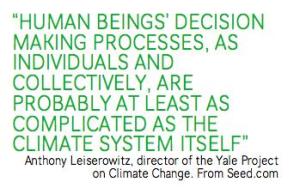 Let’s get this straight. Climate change ‘deniers’ are (mostly) not being malicious. They genuinely believe what they are saying, just like climate change ‘believers’ do. The assumption of bad faith is entirely unhelpful.
“But how can it possibly be that in the face of all the evidence people still won’t face the truth of climate change?” That’s one way of looking at it, but it depends on a mono-rational view of the world which is contested by grid-group cultural theory. A more nuanced analysis suggests that there are four, not one or two ways of organising institutions, from families to global treaties, and what counts as evidence for one cultural bias will never count as evidence for another.
So, Egalitarian environmentalists who want to promote their own view would do well to take seriously the contesting claims of Individualism, Hierarchy and Fatalism. These are not merely arguments about the evidence but deeper arguments about rationality itself.
What we argue about when we argue about global warming, then
Climate change: is it a new religion?, then
Four Ways to make Social Change Work Better.
Image source: http://artsandecology.rsablogs.org.uk/2009/04/28/emotional-appeal/
John Dewey on practical intelligence
For philosopher John Dewey, intelligence – knowledge in the absence of certainty – was a matter of judgement.
“A man[sic] is intelligent not in virtue of having reason which grasps first indemonstrable truths about fixed principles, in order to reason deductively from them to the particulars which they govern, but in virtue of his capacity to estimate the possibilities of a situation and to act in accordance with his estimate. In the large sense of the term intelligence is as practical as reason is theoretical”
(The Quest for Certainty, 1933: 170, quoted in Westbrook, 357)
It strikes me, reading this, that ‘the possibilities of a situation’ are not necessarily obvious, nor exhaustively explored in a given ‘estimate’. But that grid-group cultural theory offers a means of describing a fourfold field of possibility.
The estimate is conditioned both by what is considered personally to be the limits of possibility and by the institutional context in which certain possibilities may be expressed and others may not.
Reference: Robert B. Westbrook 1993 John Dewey and American Democracy. 2nd Edn. Ithaca, NY: Cornell University Press.
East is East and West is West and never the twain shall meet…
 Fourcultures has previously expressed frustration over the ubiquity of the fiction of ‘Eastern’ and ‘Western’ thought worlds. One antidote on offer is to read the excellent book The Shape of Ancient Thought. To get a little more up to date, another suggestion would be:
Kapil Raj. Relocating Modern Science: Circulation and the Construction of Knowledge in South Asia and Europe, 1650-1900 (Palgrave Macmillan, 2007)
This book disputes the idea that modern western knowledge originated in the West then was transmitted elsewhere (contra Basalla 1967, for instance). Instead, the author shows, fields such as botany, cartography, terrestrial surveying, linguistics, scientific education and colonial administration, all depended for their development on a good deal of intellectual coming and going between ‘East’ (with a focus here on South Asia) and ‘West’ , between colonial centres and their colonies.
Read also: How to combine Eastern and Western Philosophy
Reference: George Basalla, The Spread of Western Science. Science 5 May 1967: Vol. 156. no. 3775, pp. 611 – 622
Please help with the Fourcultures FAQ!
It’s high time this site, and the world of grid-group cultural theory, had a FAQ – a list of frequently asked questions online. SO now’s the chance to help build one.
Please visit the new FAQ creation page to:
- submit your questions,
- view what others have already asked and
- vote the best ones up the charts.
- (Or you could just leave a comment below)
Thanks!
The FAQ creator uses Google’s ‘moderator’ poll service, and this request also gives you the chance to check it out.
A Month of Resilience
 This month Four Cultures is going to be considering Resilience and its connection with Grid-group Cultural Theory.
By Resilience I mean the cross-disciplinary scientific approach inspired by the work of Canadian ecologist Buzz Holling, and promoted in a number of places, especially through the Resilience Alliance and through the Stockholm Resilience Centre.
There’s a video of him from his award of the Volvo Environment Prize in November 2008.
Chaos theory and fourcultures
More on Chaos theory, evolution and fourcultures.
Meika recently posted a piece about brain research, bias and chaos theory.
And DK asked:
How does chaos complicate or enrich evolutionary theory in biology? How does the nonlinearity that chaos features interact with mutation/drift/natural selection? Is there a canonical text (or at least something authoritative & comprehensive) on this?
I think one of the key texts on this subject is going to be Continue reading Chaos theory and fourcultures
Four Faces of Global Culture revisited
Sociologist Peter Berger wrote an article in 1997 called Four Faces of Global Culture, claiming globalization has four dominant cultures. These are: Continue reading Four Faces of Global Culture revisited
 Four Cultures