Four ways to assemble the evidence on climate change

How it is possible to persuade people who just don’t want to be persuaded?

The answer, from a Cultural Theory perspective, is fairly straightforward. People and institutions with different cultural biases create, fund, support and pay attention to four very different types of evidence. What matters then, if you want to persuade large numbers of people, is to produce and shape a variety of evidence. Here are some suggestions for what climate change might look like, viewed four different ways.

Just before we begin, note that science communicators seem to be ridiculously bad at doing this. Their so-called evidence and so-called solutions are almost always heavily weighted towards the Egalitarian version of climate change alone, which is why their views are contested. As we’re about to show, there’s much more to life than egalitarianism, but since that’s how much of the climate discourse is presented, that’s where we’ll start.

Egalitarian Climate Change:

On this view you should demonstrate with science and/or emotive rhetoric (whichever appeals best to hearts and minds, the Elephant and the rider as Jonathan Haidt would say) that our very civilization is in danger unless we change our profligate ways. Changing our energy sources is to be depicted as only a preliminary step to changing our values. Peter Preston said we need an ‘eco-prophet’ to show us how to believe but this is emphatically wrong. Such Egalitarian eco-prophets as have arisen – Al Gore in the US, George Monbiot in the UK, and many others – have been shot down in flames, derided as extremists.

Egalitarian authority comes most authentically not from prophets but from the masses. Common sense, what everyone knows, is what is true. That’s why ‘scientific consensus’ is so much more important to Egalitarians than it is to scientists themselves (scientists themselves rather like arguing and starting feuds).

The reason science communicators shouldn’t just bang on about deadly threats and fragility and about changing our values is that most people don’t warm to these egalitarian signals. For example, many people are more in tune with an Individualist worldview, which is quite different.

Individualist Climate Change:

From an Individualist perspective you should provide information and examples on how to make a profit from climate change, appealing all the while to visceral self-interest. If it turns out you actually can make a profit from climate change, and do so better than your competitors, then climate change must surely exist.

Alternatively, and inversely, demonstrate concrete (not hypothetical or future) impacts on the bottom line of those institutions that have ignored Climate Change.

On this view scientists who make photovoltaics competitive with coal fired power stations are doing more to combat climate change than any amount of hand-wringing by the likes of James Hanson, who is simply discounted as a crypto-religious or crypto-communist ‘fanatical environmentalist’. A figurehead Individualist expert would be someone like Shi Zhengrong, China’s first solar billionaire. Money doesn’t lie.

Hierarchical Climate Change

Paying attention to the Hierarchical perspective you should develop and promote management theories of climate change. If you can reconfigure governance to take account of climate change in ways that enhance management functions, and if it makes evident sense to have a Minister for Climate Change, then climate change must certainly exist.

Alternatively, demonstrate (perhaps by means of case study) real and damaging governance failures of those institutions that have ignored Climate Change in their management structure. What risks demonstrably increase when you don’t have a Minister for Climate Change or a framework for global climate change governance? Ideal Hierarchical experts will be at or near the top of the tree. It will be their status that speaks loudest. If Prince Charles and the Pope both worry about climate change, who are we to argue? Failing the biggest guns, the Head of the Royal Society will do at a pinch, unless you can find someone more senior.

Fatalist Climate Change

With reference to the Fatalist perspective you should demonstrate the randomizing impact of climate change on the status quo. Fatalism thrives by enhancing and systematizing the luck of the draw and turning it into policy (explicit or, more often than not, tacit), or reward (the lottery). Fatalists tend to say ‘climates change!’ with the twin implications that it was always like this and there’s nothing anyone can do about it. Fatalist institutions tend to make a virtue of doing nothing about it, and try to make sure no one else does anything about it either.

What not to do

If you keep using only one of the four perspectives described by Cultural Theory, your message will appeal to some people but deeply antagonise many others. It will be welcomed in some social settings but shunned in others. Don’t keep doing this, because so far it hasn’t worked.

There is nothing wrong with professing the view that in light of dangerous climate change problems what the world needs now is global governance. But to expect that this will not be seen as politically inflammatory is to be naive in the extreme. The global governance line works well before Hierarchical audiences (bureaucrats and some heads of state, for instance), but really badly before audiences with the other three cultural biases.

Simply put, any media release about a new piece of climate research could do with not one but four different versions, each targeted at a different cultural bias. A more sophisticated version of this would be to develop a communications strategy which includes interaction with all four cultural world views, not just with one or two, as at present.

A little help from Aristotle

But that’s not quite enough. Prof Dan Kahn at the Cultural Cognition Project has suggested that any message about science really has two channels: the content itself, and the cultural meaning attached to that content. He rightly suggests communicators need to be aware of both. But his model reminded me of Aristotle, who thought there were three, not just two, channels of communication.

In presenting an argument, Aristotle’s classic rhetorical concepts of ethos, pathos and logos still have a great deal to contribute (Gottweis in Fisher, Miller and Sidney, 2007: 237-250). Too many presentations rely almost exclusively on logos, the actual ideas and concepts, the contents of the presentation. This is certainly important but in some ways overshadowed by the other two. Pathos refers to the emotions evoked and ethos refers to the character of the person delivering the message. These are both highly important but often underused. The implication of Cultural Theory is that all three, ethos, pathos and logos, are configured according to the main cultural biases. An egalitarian logos, for example, may work best when it is supported by Egalitarian pathos and Egalitarian ethos. On the other hand, a speaker trying to appeal to an Individualist audience may keep some of the Egalitarian logos, while appealing to an Individualist pathos and using an Individualist ethos.

More reading:

The dark side of Cultural Theory

Edit: changed the title of this post from ‘make up’ to ‘assemble’. See the discussion in the comments. And edited 16th October 2023 to link the egalitarian and individualist sections a bit more clearly.

A two-bit theory of social reality

English: Publicity photo from the game show Tw...
Image via Wikipedia

It is not obvious whether the world is analogue or binary, continuous or discrete. It’s a live question and the subject of a recent essay contest set up by the Foundational Questions Institute.

That said it seems clear that much or our social lives revolves around the assumption that the world is indeed binary. Male or female, black or white, left or right – simple binary oppositions structure our social relationships through and through. Moreover, we live in an era when developments in technology make it abundantly clear that the bifurcation of the universe into one and zero brings great leaps forward. Why do we do this to ourselves? What possible benefit can it confer?

One answer might be that it makes things simpler, thus allowing us to make faster decisions.

The reason Twenty Questions pretty much works as a parlour game is that twenty yes/no answers are all it takes to distinguish between 1,048,576 (220) discrete subjects. This seems to be roughly the high end of a practical taxonomy for personal use. By way of comparison, note that if one was to play the game using English Wikipedia articles it would need to be renamed Twenty-Two Questions to cover the 3,673,861 articles in existence in mid-2011 (222 = 4,194,304).

The promise of information theory, on some accounts, is that we can sort everything in binary terms. In John Wheeler’s well-known formulation, ‘it from bit’:

“It is not unreasonable to imagine that information sits at the core of physics, just as it sits at the core of a computer.

It from bit. Otherwise put, every ‘it’—every particle, every field of force, even the space-time continuum itself—derives its function, its meaning, its very existence entirely—even if in some contexts indirectly—from the apparatus-elicited answers to yes-or-no questions, binary choices, bits. ‘It from bit’ symbolizes the idea that every item of the physical world has at bottom—a very deep bottom, in most instances—an immaterial source and explanation; that which we call reality arises in the last analysis from the posing of yes–no questions and the registering of equipment-evoked responses; in short, that all things physical are information-theoretic in origin and that this is a participatory universe.” (John Archibald Wheeler 1990: 5)

In physics perhaps (more generally, in the ‘ontological basement’, as Paul Davies puts it). But as any one who has ever heard of racism or sexism will recognise, splitting the social world into opposed pairs often makes us get things very, very wrong. Our fondness for quick and dirty social heuristics has a habit of misleading us. Simpler does not by any means equate to more correct. Reality is more complex than a game of Twenty Questions and it takes more than yes/no answers to parse the social.

So it is not surprising that when faced with various kinds of binary sorting mechanism we experience a sense of disappointment. What may have seemed like a good idea – to simplify by means of bifurcation – turns out to produce less than useful information. The left/right dichotomy in politics turns out to be forced and to obscure almost as much as it reveals. Similarly it turns out that gender is a poor indicator of ability to own property or many of the other issues it has historically been used to indicate. And as for skin colour, this seems to produce far more noise than signal…. It is as though the usefulness of binary sorting has got the better of us and instead of recognising its limits we have tried to sort everything in binary terms. The reward is conservation of energy. The cost is accuracy.

What if the cost is too high? A recent example is a paper claiming to provide insights into differences between national cultures on the basis of a distinction between ‘tight’ and ‘loose’ cultures. This is a fairly well-rehearsed but contentious pair of categories that derives from anthropology.

The problem is that the ranking of nations on this basis doesn’t appear to shed much light on the national characteristics in question. Again, what is claimed to be signal looks suspiciously like noise.

I remain to be convinced but in the meantime I want to propose an interim alternative.

Instead of simplifying by means of one bit of information (tight/loose, black/white, male/female, left/right) we should do so by means of at least two bits of information.

It seems to me that a binary choice, between yes and no or between 1 and 0 always implies a set of Boolean operands just waiting to be used. Yes or no always begs the question: Yes and no?

One way of depicting this expanded set of choices is to frame each binary single bit choice as a two bit choice:

YES                 Yes and not No                      Yes and No

NOT YES       Not Yes and not No              No and not Yes

                          NOT NO                                           NO

This is not to suggest that reality actually is made up of two bits, or any other number of bits for that matter, information theorists notwithstanding. Rather, my claim is that if, in seeking to understand the social world, there is indeed a sweet spot somewhere between energy conservation and accuracy, then a two bit heuristic process is closer to that sweet spot than our current dominant but misleading fondness for single bit, yes/no thinking.

It from two bits.

References:

Differences Between Tight and Loose Cultures: A 33-Nation Study

Michele J. Gelfand, Jana L. Raver, Lisa Nishii, Lisa M. Leslie, Janetta Lun, Beng Chong Lim, Lili Duan, Assaf Almaliach, Soon Ang, Jakobina Arnadottir, Zeynep Aycan, Klaus Boehnke, Pawel Boski, Rosa Cabecinhas, Darius Chan, Jagdeep Chhokar, Alessia D’Amato, Montse Ferrer, Iris C. Fischlmayr, Ronald Fischer, Marta Fülöp, James Georgas, Emiko S. Kashima, Yoshishima Kashima, Kibum Kim, Alain Lempereur, Patricia Marquez, Rozhan Othman, Bert Overlaet, Penny Panagiotopoulou, Karl Peltzer, Lorena R. Perez-Florizno, Larisa Ponomarenko, Anu Realo, Vidar Schei, Manfred Schmitt, Peter B. Smith, Nazar Soomro, Erna Szabo, Nalinee Taveesin, Midori Toyama, Evert Van de Vliert, Naharika Vohra, Colleen Ward, and Susumu Yamaguchi

Science 27 May 2011: 332 (6033), 1100-1104. [DOI:10.1126/science.1197754]

Why do People play the Lottery?

Question mark
Image via Wikipedia

Well, why do they? It’s the kind of question only those who don’t do it would bother asking. I admit I’m one of them. The lottery is a mystery to me – self-evidently daft,  like a slow-motion version of taking a pile of cash and setting fire to it. Why would anyone do it?

One way of answering this kind of question is presented by science journalist Jonah Lehrer: let’s ask some behavioural economists!

The chief conclusion is as follows:

In two experiments conducted with low-income participants, we examine how implicit comparisons with other income classes increase low-income individuals’ desire to play the lottery. In Experiment 1, participants were more likely to purchase lottery tickets when they were primed to perceive that their own income was low relative to an implicit standard. In Experiment 2, participants purchased more tickets when they considered situations in which rich people or poor people receive advantages, implicitly highlighting the fact that everyone has an equal chance of winning the lottery.

An Unsafe Bet

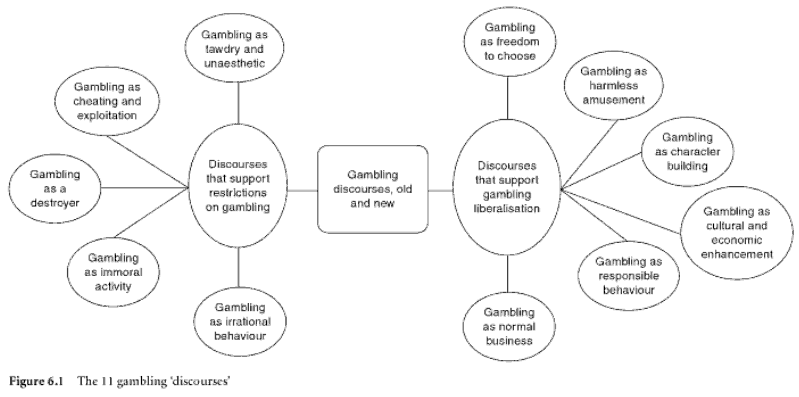
Jim Orford has a book out entitled An Unsafe Bet? The Dangerous Expansion of Gambling and the Debate we should be having. In it he identifies eleven commonly used discourses of gambling. Of these six discourses broadly support the liberalisation of gambling and five support the increase of restrictions on gambling. Orford is fairly relaxed about this typology and even says: ‘Other people would no doubt produce a different list’ (123).

This to Fourcultures is as a red rag to a bull, so here goes.

Source: Orford 2011:124

False Signal?

Two people on the shore of the Pacific Ocean
Image via Wikipedia

“My father told me the oceans were limitless, but that was a false signal.”

NYT on collapsing fish stocks in the South Pacific.

In Mackerel’s Plunder, Hints of Epic Fish Collapse


Leadership Mismatch – what Napoleon can tell us about the evolution of leaders

Elba seen from Tuscany

The Emperor Napoleon was a consummate manipulator of other people’s expectations regarding leadership roles, and here’s how you can be too…

In an RSA lecture Matthew Taylor engages Mark van Vugt, author of Selected, over the salience of Cultural Theory to van Vugt’s evolutionary theory of leadership. [about 30:00 in]

Professor van Vugt’s idea is that evolution has primed humans for particular types of leadership which are not now particularly helpful. There is a kind of mismatch between the leadership relevant to Stone Age peoples and the radically altered demands of today.

He and his collaborators identify two key types of leadership justification:

  • The first is the ‘servant’ leadership approach , which claims that leaders benefit the group at a cost to themselves.
  • The second is the ‘selfish’ leadership approach, which says the opposite – that leaders benefit themselves at a cost to the group.

Source: Gillet, J., et al. 2010

According to social psychology there are two dominant understandings of the evolution of leadership. The first sees leadership as a kind of by-product of the struggle for social dominance. The struggle for dominance takes place because the winners secure better access to ‘reproductively relevant resources’ (I think this means mates). The dominant individuals by definition ‘occupy the top positions in the hierarchy’ and therefore ‘can exercise power over lower-ranked individuals’.

The second approach sees leadership not as a by-product of dominance battles but as a key aspect of group coordination: Leaders are useful to their followers ‘because they can reap the benefits of being in a highly coordinated and cohesive group.’

If these are the only two versions of leadership allowable, we have a big problem. The ‘selfish’ dominance model fits very well with the Individualism worldview of Cultural theory. In this worldview the purpose of leadership is to advance the individual. While not everyone actually is a leader, everyone theoretically could be. The individualist exhortation is to find the niche within which it is possible to fulfil one’s leadership potential. A hundred business speakers’ careers have thrived on this approach (a recent example of this trope in full swing is to be found in Seth Godin’s Lynchpin and Tribes books – strap line: we need you to lead us).

The ‘servant’ coordination model fits very well with the Egalitarian worldview of Cultural Theory. In this worldview the purpose of leadership begins and ends with the benefit of the group as a whole. Ideal leadership is somewhat communal (for example the group of presbyters who lead a Presbyterian church, replacing the individual bishop with a leadership group. The presbyters hire and fire the minister, not the other way around). Ideal decisionmaking is consensual, in which all make the leadership decisions (for example in a Quaker business meeting).

A working hypothesis based on Cultural Theory would be that these (dominance vs. coordination or selfish vs. servant) are only two of the possible four worldviews or cultural biases available. They are the two which fit along the Group axis. Strong Group is associated with servant leaders, which weak group is associated with selfish leaders. However, in Cultural Theory there is another axis, the Grid axis, which considers the relative significance of regulation, rules, expected social roles. A strong Grid approach to leadership makes leadership strongly deterministic. Weak Grid leadership takes little account of (or actively disparages) organised institutions of leadership. Weak Grid leadership produces two varieties just described – Selfish (Individualist) and Servant (Egalitarian). The two strong Grid leadership patterns are Hierarchical leadership and Fatalist leadership.

We could say that on the Grid axis we are measuring over-determined leadership vs. under-determined leadership.

In over-determined leadership there is a pre-established understanding and expectation of what the leadership roles will look like. In the struggle for dominance would-be leaders are not creating the social hierarchy from scratch, instead they are following well worn upward steps. The over-determined leadership contest asks, for instance ‘who will be the next king?’ The role of monarch already exists, it is well-defined and the would-be leaders vie with one another to fill the pre-existing role. Thus the nature of leadership itself is almost entirely unproblematic. A strong grid organisation will have an ideology that assumes the leadership roles are fixed eternally. This is certainly true of the monarchy, where it is mythologised that successive rulers all descend from one another (yet a brief overview of any monarchy will quickly show this to be a fabrication). But it is also true of a modern bureaucracy in which the name plate on the office door or car parking space shows the job title eternally unchanged but the individual title holder ephemeral (again, an examination of actual workplaces shows this to be a fiction – in many workplaces the individuals outlast the management reorganisations that create and destroy their job titles and whole departments regularly and almost ceaselessly).

The under-determined leadership contest, in contrast, actively worries about the nature of leadership itself. Roles, expectations, precedents are all much more fluid and subject to reinterpretation. Instead of slotting into a given role, weak Grid leaders bring with them their own leadership style. A clear example is Napoleon Bonaparte, who went from being a Corsican nationalist lieutenant Colonel to being a French republican captain then General then First Consul in a Republic (he wrote his own constitution) to Emperor in a self-created empire (he crowned himself and subsequently made kings of his brothers, brother-in-law and son). His political formation was in weak Grid Corsica: “As the nation [Corsica] was perishing I was born” (McLynn 1998: 37).

Napoleon was a consummate manipulator of other people’s expectations regarding leadership roles. On his return to France having escaped from the Isle of Elba (see photo at top) he faced unarmed and alone the French 5th Regiment that had orders to re-arrest him. “Here I am.” he told them, “Kill your Emperor if you wish.” Instead they shouted “Vive l’Empereur!” and marched with him to Paris to depose Louis XVIII (McLynn 1998: 605).

Mismatch hypothesis: ‘our modern environments look very different from our ancestral environments’ Example: why do we tend to vote for taller political candidates when height has nothing to do with their job as politicians.

The assumption being made here is that we are genetically predisposed to be impressed by tall people because our Stone Age ancestors were. But this is a cognitive trap, since it no longer matters how tall the leader is.

A counter-suggeston is that only certain cultural biases are interested in the height of the leader.  Individualist leadership is definitely interested, but only to the extent that height can be used as a proxy for individual prowess. Hierarchical leadership is impressed largely because height (like gender, race, age etc) is one more easy item to rank. Egalitarian leadership is quite unimpressed by height (in Australia, this tendency is known as the ‘tall poppy syndrome’ and any potential leader who stands out above the crowd will be ruthlessly cut down to size). Fatalist leadership knows full well that one’s height is the luck of the draw.

Interestingly, despite his many and various leadership achievements, tall is one thing Napoleon wasn’t.

My suggestion: it’s the environment that creates the leadership much as the terrain creates the apparent complexity of the ant’s path across the beach (Simon 1969: 24-25; cf. Agre 1997: 56)

References

Avolio, B., Walumbwa, F. O., Weber, T. J. (2009). Leadership: Current theories, research and future directions. Annual Review of Psychology, 60, 421-449.

Gillet, J., et al. Selfish or servant leadership? Evolutionary predictions on leadership personalities in coordination games. Personality and Individual Differences (2010), doi:10.1016/j.paid.2010.06.003

Frank McLynn 1998 Napoleon . London: Pimlico.

Mark van Vugt and Anjana Ahuja 2010 Selected: Why some people lead, why others follow, and why it matters. London: Profile.

Image Credit: CC, adapted from Gabriele Delhey/Wikimedia