On the science and politics of climate change

photo of Mike HulmeMike Hulme, author of the splendid Why We Disagree about Climate Change, has written a very measured op-ed about the theft of his emails from the University of East Anglia and the relationship between science and politics in the climate change debate.

Fourcultures has previously written about:

  • Mike Hulme’s book, Why we Disagree about Climate Change
  • a critique of the idea that climate change deniers are necessarily acting in bad faith
  • the climate change debate as an exercise in four types of deviance
  • and quite a lot more on the social aspects of climate change.

Expanders, Restrainers, Managers and Shruggers

field of sunflowersJournalist George Monbiot has characterised the climate change debate as being not between conservatives and liberals, but between ‘expanders’ and ‘restrainers’. These categories make sense and you probably already have a good idea of who’s in which camp. People often get annoyed with the climate change warning team because they seem to want to restrain everything. And they’re frustrated by the climate change denial cheerleaders because they seem to see no limits to anything at all.

If you have been reading the Fourcultures website at all you’ll know that it makes sense to think of four, not merely two, cultural biases. In other words there’s more than just expanders and restrainers. You’ll also quickly spot that the two biases Monbiot misses out are ‘managers’ and ‘shruggers’.
The managers see expansion and restraint as equally dangerous to the establishment and their aim is to manage resources so that the established order is maintained. As long as the status quo prevails, there’s room for both expansion and restraint. For managers it is crucial that there is control over who gets to expand and who gets restrained. Most global governance attempts, including the Copenhagen climate talks, are dominated by this worldview, with the others shouting loudly at the margins (demonstrating), or talking confidentially behind closed doors (lobbying).
The shruggers are those who think it’s a joke that we can control any of this. In the midst of the great moment advertised by Monbiot, ‘the moment at which we turn and face ourselves’, they (we) are more interested in which team will win at sport, or whether some star’s been having an affair.

Expanders – Individualist (low grid, low group)
Restrainers – Egalitarian (low grid, high group)
Managers – Hierarchical (high grid, high group)
Shruggers – Fatalist (high grid, low group)

Is it necessary for God to be doing anything different from the laws of physics?

Victor Stenger, is the author of  God, the Failed Hypothesis – How Science Shows that God does not Exist.

The book claims:

Not only does the universe show no evidence for God, it looks exactly as it would be expected to look if there is no God.

I would frame this slightly differently and suggest that

the evidence in favour of the existence of God is exactly the same as the evidence against the existence of God.

It may seem like a small difference but I think it’s important. Here’s why. Continue reading Is it necessary for God to be doing anything different from the laws of physics?

Fourcultures – the most popular posts of 2009

Many thanks to everyone who’s read these pages over the year that’s now ending. Fourcultures is now being read more than 2,000 times a month.

And just in case you missed them, the most popular posts of 2009 are as follows:

The Four Cultures of Marketing Ethics
Grid-Group Cultural Theory: a way of trying not to fool yourself
Post-Secular Artist? Nine Reflections on Patrick Heron
Four Ways to Make Social Change Work Better
How to be a Fatalist

Here’s to 2010. Happy New Year!

Making up the facts about climate change?

Climate Change Factors

Upton Sinclair said

“It is difficult to get a man to understand something when his salary depends on his not understanding it.”

Let’s just try to understand a fairly straightforward question. I don’t mean straightforward as in ‘easy to determine’ , but as in ‘you’d think it might have a definite, clear answer’. Here it is:

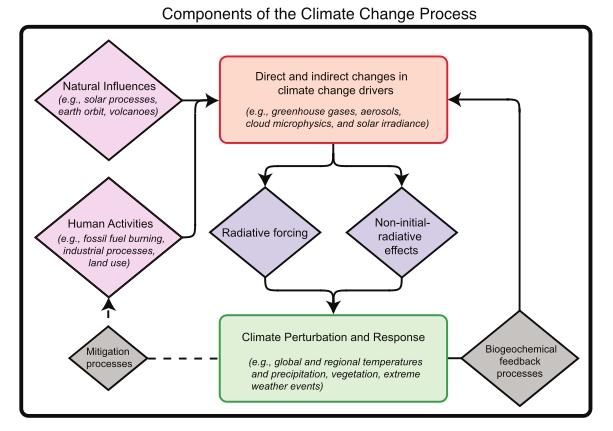
How much carbon dioxide do volcanoes emit?

This seems exactly the kind of question we should be able to answer if we want to be able to say anything serious about climate change (see the top left box of the diagram). It also seems to be the kind of thing that scientific observation and measurement ought to be able to help us with.

Furthermore, it would in principle be perfectly reasonable to conclude that we don’t actually have an answer yet because it’s just too hard to measure volcanoes with existing methods and technology. A little humility never hurt anyone.

So here goes with the answer. Continue reading Making up the facts about climate change?

Where have all the climate change jokes gone?

Why can’t anyone tell a good joke about climate change? I don’t mean “Climate Change? That’s a joke in itself”. And I don’t mean jokes in the Leno/O’Brien/Letterman-style: ‘Scientists are warning that if climate change gets any worse even Hilary Clinton will thaw out’. I mean funny ones. Where are they?
The Times wrote about this and the online comments were as miserable, mean-spirited and loopy as usual with this subject. Humour hardly began to get a look-in. The same happened a year or so ago when the Guardian ran a very similar piece.

If anyone has a good joke about climate change I’d love to hear it.

More on Open Access journals

Just a few links really, call it self-education…

There’s a new popular book out about some of the issues. Viral Spiral by David Bollier. (also exists as free pdf download).

And The Access Principle is a bit of a classic (if anything can be after just four years). Free pdf requires registration.

A real world case study I found illuminating, on the Canadian Journal of Sociology.

Read also:
Open access to publicly funded knowledge

Which of my identities takes precedence?

Mort recently asked the following:

Where does cultural cognition reside?Is it within the individual or their cultural environ – the social assumptions and influences that we are surrounded by?
Which of my identities takes precedence, me the autonomous decision maker, or me the social role?

Thanks for reading and for your encouragement Mort. I think your question is very important. Much of our discussion about human interaction assumes the basic unit is the individual, somehow isolated from their environment. Economics has been particularly successful at describing the world in terms of the utility-maximising rational individual. Psychology has progressed on the assumption that much of what matters about human behaviour is to be found inside individual brains. As a broadly sociological theory , though, Cultural Theory is compatible with the sociological idea that the basic unit of study is not the individual alone, but the person-in-relationship. In other words it is held that what is distinctive is our connections, that without taking account of my context I can hardly make sense of ‘me’. For a long time this was problematic – there were many debates about the relative significance of ‘structure’ (the context) and ‘agency’ (the actions of people in, and sometimes in spite of, that context). Anthony Giddens’ structuration theory was just one of many attempts to connect the vision of the individual with the vision of the social. Most were rather unsatisfactory. A few changes in the last decade or so have shifted these debates quite dramatically.
First there is the rise of social network theory. This studies the links between people and has lately grown in importance. You can see that if you study the links you no longer ask ‘is it the individual or the group that matters?’ Studying the ties, the relationships, tells us something about both the groups and the individuals that we wouldn’t have grasped otherwise.
Second, there is the rise of evolutionary psychology. This argues that some of what we previously took to be humans making choices about their circumstances can actually be explained in biological terms. But note that just as it takes some of the explanatory power away from ‘society’, it also offers new scope for social factors to be influencing biology, for if adaptation is a key mechanism, then the environment of evolutionary adaptedness is a central consideration.
Third, sitting within this biologocal turn, but worth noting in its own right is the advance of game theory. This has shown that mechanisms other than genetic heredity and mutation can impact on evolution. Games are entirely social/relational and not biological, and yet they have the capacity to influence biology through evolution.
Each of these frameworks of research is reconfiguring, sometimes quite radically, our ideas about what makes up the ‘individual’ and what makes up the ‘social’. Many of our ideas from the past are no longer viable and we are still coming to terms with this. But also, many of these new ideas are contested within their own fields and many issues are far from settled.
Grid-group cultural theory was developed before some of the importance of these big shifts became apparent and basically sits within what evolutionary psychologists like to to call the Standard Social Science Model (SSSM), which they challenge. My own view is that it can make a distinctive contribution. I am exploring the idea that the four cultures described by Mary Douglas, her collaborators and followers can be reframed as examples of ‘ecologically adaptive heuristics’ as described by psychologist Gerd Gigerenzer.

Further, as I have previously written:

there surely is an important and little understood link between the human and the natural sciences to which Cultural Theory may contribute something. I’m pretty certain it has something reasonably substantial to contribute to what Paul E Griffiths and Karola Stotz call ‘biohumanities‘. My hunch, further, is that grid-group cultural theory might be open to game-theoretical modelling, and that this would then offer something to evolutionary theory, in the way that Axelrod’s evolution of cooperation did. Specifically it might further develop some of the ideas of Brian Skyrms on the Stag Hunt and the evolution of culture.

There is a good summary of Douglas and Ney’s Missing Persons (1998), which points to some of this.

And since you mentioned coutural cognition, you should go straight to the fount of wisdom on this: The Cultural Cognition Project.

That was the Y2K that wasn’t


‘No planes fell from the sky, but a lot happened to keep them from doing so’.

http://americanradioworks.publicradio.org/features/y2k/notebook.html


This is a common view of the Y2K bug among software engineers and IT professionals in Anglo-American societies. For them it may be true that their hard work saved civilization from digitally-challenged-date Armageddon, but everywhere else in the world, they did next to nothing and yet, conspicuously, planes still didn’t fall from the sky.

So what was going on?

The story of Y2K bug is a marvellous example of how our subjective conceptions don’t just shape our view of reality, they shape objective reality itself.

Was the Y2K bug a serious threat or not? You’d think there’d be a straight and clear answer to this question, but it seems impossible to find one. The distinction between subjective and objective truth appears to dissolve before our eyes and if it can do so in relation to a super-expensive, high-stakes, world-wide emergency like Y2K, where else can it similarly dissolve?

The outcome of the Y2K bug has been used as a vindication of the ‘precautionary principle’ but also as a critique of that principle and an argument in favour of the ‘fix on failure’ principle. Most of the positive reporting has focussed on the positive ‘unintended consequences’, the ‘surprising legacy’ of Y2K preparation (especially the structural development of the IT industry) rather than demonstrating that a disaster actually was averted.

Economist John Quiggin has been the single most cogent thinker on Y2K, especially since his measured scepticism predates the benefit of hindsight. Two of the points he makes are especially worth reflecting on: blame-allocation schemes generally produce bad policy; some form of institutionally-sanctioned scepticism is indispensable.

Below is a list of resources, placed in order of increasing depth of coverage/insight.


Newsweek’s list of most overblown fears

Article from Slate Magazine

US Senate Committee final report

Public Radio miniseries – the surprising legacy of Y2K

Phillimore, J and Davison, A (2002) A precautionary tale: Y2K and the politics of foresight. Futures, 34 (2). pp. 147-157.

John Quiggin paper

More Quiggin


For a fourcultures take on this kind of thing, see The Dam Bursts.


What kind of duty is called for in Call of Duty?

Games have several important effects. One is that they train us to accept the premise of the game.

If I don’t accept that a knight moves two spaces forwards and one sideways, I simply can’t play chess. If I don’t accept that mass murder is necessary, I simply can’t play Call of Duty: Modern Warfare 2.

Reflecting on this latter experience, one commentator wrote:

I thought, You don’t have to do this. You can stop. You can refuse. You can walk away. I didn’t.

Trying to avoid the endless killing doesn’t work, any more than changing the knight’s move would in chess. And mostly, we just go along with the premise imposed on us by the structure of the game. In games we learn very quickly which rules we shouldn’t bother challenging. In real life, we have far more freedom of action, but we rely on social constructions of the rules of life to tell us which obstacles we shouldn’t even bother trying to overcome. We are like cattle that never even touch the electric fence. Even as we proclaim our freedom, we corral ourselves.

It’s hard to break out of that paddock. But what we can’t yet achieve politically we can sometimes achieve artistically. As soon as I heard about the extraordinary sales figures of the latest Call of Duty game sequel, I thought this is a very suitable subject for artist/provocateur Joseph DeLappe (of ‘Dead in Iraq’, 2006 and the Second Life Salt Satyagraha, 2008). It turns out he’s already been there, with a machinima collaboration named 6 Days in Call of Duty 4, an ironic take on the ill-fated game Six Days in Fallujah. It seems what made Six Days in Fallujah unsellable was that it was regarded as too realistic.  DeLappe and his collaborator Joshua Diltz have taken this idea and used it to test the limits of what is possible in an ‘acceptable’ shoot-em-up game.

Here’s the download page.

6 Days

Update: The Onion has a satirical take on a ‘realistic’ wargame, Call of Duty 3, in which players can opt to complain about cell phone reception and  be redeployed to Germany to repair humvees for 10 hours a day.