Economics of the Singularity

Crooked Timber has been running a ‘book event‘ on the economic ideas of science fiction writer Charlie Stross.

In case you haven’t come across him, Stross is a prolific (300,000 words a year) writer of extravagant ideas who lives in Scotland. His approach to  pulp sci-fi is reminiscent of  Philip K Dick’s.  Sure it’s commercial, but with Stross as with Dick, it’s also art.

Perhaps the thought of economics puts you off an otherwise good read. Or perhaps the thought of science fiction puts you off some otherwise good economics. But for anyone still left in the room, the discussion, including posts by economists Paul Krugman and John Quiggin, as well as by writer Ken MacLeod, is well worth reading.

Warning: cheap joke ahead.

Of course, some might say all economics is fiction…

What to do when your Blog is bigger than Ben Hur

What should you do when your blog is too big to know your name?

In BusinessWeek, Sarah Lacy reports on how blogging multi-millionaire Jason Calacanis is ‘retiring’:
“Blogging is simply too big, too impersonal, and lacks the intimacy that drew me to it” he says.

It seems he’s turned to the timeless, homespun, traditional craft of hand-made…
Emails.

‘There is something about the acoustic, intimate nature of email that is impacting how I write,’ he says on his blog – even though he’s ‘retired’, ‘I’m writing every sentence as if I’m looking someone in the eye and speaking directly to them.’

Fortunately, this site will never be big or impersonal, and will always be packed full of intimacy. Unless someone wants to offer, say $25million. Jason will understand.

What about you? Do you prefer the small and the intimate, or the big and the brash? What do you come to a tiny site like this for anyway? As you post a comment, just remember I’m looking you in the eye and speaking directly to you right this moment.

Can Wikipedia entries on artists be improved?

Jonathan Jones has been complaining about the banal way in which Wikipedia covers art and artists. He cites the entry for Goya as an example.

Drawing Space in Colour

I thought I’d test this by checking out the entry on Patrick Heron, an artist I’d like to think I know a little bit about. Here’s what I found…

Plenty of summary background information, but almost nothing about the art itself.

This can be repaired by pointing towards Andrew Wilson’s excellent essay, Drawing Space in Colour, for the 2008 Heron exhibition at the San Francisco Hackett-Freedman Gallery – the first American exhibition since Heron’s death in 1999.

http://hackettfreedman.com/templates/publications.jsp?id=175

The problem with amateurs is that they’re (we’re) amateurs. They have the time, but not necessarily the depth. Meanwhile the experts currently have the depth but not the time. Is it a public service to improve Wikipedia entries, or is it just an opportunistic means of getting  content for free?

How to do Belief-free Science

Harry Kroto produced a remarkable defence of the sacking of Michael Reiss from his post with the Royal Society. Remarkable in what it assumes about the scientific method. (And thanks to Benjamin Carnys for pointing it out).

Kroto writes:

Science is based solely on doubt-based, disinterested examination of the natural and physical world. It is entirely independent of personal belief. There is a very important, fundamental concomitant – that is to accept absolutely nothing whatsoever, for which there is no evidence, as having any fundamental validity.

A little later he writes that Reiss and all religious people

fall at the first hurdle of the main requirement for honest scientific discussion because they accept unfound dogma as having fundamental significance.

Taking Kroto seriously I offer a couple of suggestions for conducting belief-free science.

First, all conceivable research projects must be available for investigation and must be chosen purely at random. Since personal beliefs are to be independent of science, there can be no a priori assessment of which phenomena are deserving of study, nor any assessment of which viable projects should be chosen over other viable projects.  For instance, becoming a chemist rather than a physicist (or vice versa) would be unreasonable. The task of documenting all possible research projects is clearly enormous and will probably last eternally, but this labour must be completed before a random decision is made about which projects to pursue.

There are a couple of alternatives to this approach which are clearly, on Kroto’s reasoning, unacceptable. One alternative is to do the research that is actually funded by somebody. However, this would involve the forbidden act of taking account of the funders’ personal beliefs about valuable research activity. Another alternative is to commit to promising research, even where it is not yet funded, and seek funds to facilitate the research. However, this would involve the researcher’s own beliefs about what counts as promising.

In short, to make a disinterested examination of the natural and physical world, independent of personal belief, is to examine everything, always, simultaneously, without discrimination, for any discrimination would have to involve some form of a priori belief. The moment we decide what to study we have ceased to be disinterested, and have taken a leap of faith. Pragmatically, one could operate on the basis that any research project might yield results, so the choice is entirely arbitrary – but this is itself an act of faith.

Secondly, scientific research must not be conducted with the involvement of humans. The trouble with humans is that they insist on having a point of view. They have a perspective, formed by the possibilities and limitations of their senses, and this feature clouds their ability to observe and record impartially in a disinterested manner. Having a point of view amounts to the belief (forbidden by Kroto) that one point of view is valid over and against other possible or actual points of view. Self-organising robots would be much better suited to the scientific task, were it not for the fact that they would also have a point of view (or a composite point of view).

It seems humans are fundamentally unqualified to practice Kroto’s scientific method. The ideal scientist, on Kroto’s terms, would, to avoid discriminating between research projects, possess an eternity in which to work and would, to avoid perspectivalism, be everywhere at once. In other words, Kroto’s ideal scientist would have the characteristics of God himself.

If you have read this far you will have noticed I am arguing for a view of science in which science is a social practice as much as any other human activity. We don’t have to be gods to participate – just humans (although the discoverers of C60 may well qualify as gods in some pantheon or other). As such we should not be worried about our human characteristics, including what Kroto calls ‘personal belief’. Positivists (is Kroto one?) seem to hate that kind of claim.  Kroto’s own science video project, Vega, is an excellent example of the embeddedness of science in social, human, belief-laden practices. At base, the belief that science education of this sort is a good idea is a type of ‘unfounded dogma’ in the sense that it can only really be argued for, not finally demonstrated.

Exit Reality – linking virtual worlds?

I really want the 3D web to work. My dream, and I suspect I’m hardly alone, is for the entire web to be browsable as though it was all Second Life.  In a recent post I wrote:

Eventually, the many virtual environments out there (in there) will begin to connect and coalesce. Like the door at the back of the wardrobe that leads to Narnia, there will soon be portals from and to Second Life and Google and, crucially into which the standard text-based experience of will be embedded.

‘An example of how this could work is given by Australian company, ‘ExitReality’. Of the virtual environments so far established, theirs has most fully grasped the concept of integrating the 3D web with the 2D web. The aim is to make virtual environments like Second Life integrate seamlessly with text-based social web environments such as Facebook. In stitching up the web in this way the potential of both the book metaphor and the world metaphor is greatly enhanced. The 2D web becomes attractive at last; the 3D web finally becomes useful.’

So I was excited when Exit Reality finally went live. I tried it. It looked a bit like Second Life. I turned my blog into a lage 3D hall and walked around it a bit. Cool. Well it would have been if it hadn’t been so slow to render and if it hadn’t crashed my browser twice.

If that hasn’t put you off, you can try it here.

I don’t mean it to put you off. I really want the 3D web to work. I really want Exit Reality to work, and I’m sure it will, because it’s just too good an idea to fail.

But I’m still dreaming.

God-like Google?

Nick Carr posted a piece about the ‘Omnigoogle’, accusing it of being messianic in tone. People seem confused about the status of Google. it can be clarified thus.

  1. Although Google’s working mantra is supposedly ‘don’t be evil’, evil is exactly what it has been doing in relation to Chinese censorship. This makes it a lot like a number of other US based companies who will do anything the Chinese government wants as long as there is money to be made. Google is no different from American business generally in this regard. It’s the same old same old. Compare US business attitudes to pre-war Germany.
  2. If there was ever an organisation with deep connections to the CIA, Google is it. I’m not a conspiracy theorist. It’s just obvious that if the CIA isn’t deeply involved they’ve missed the best opportunity in the history of intelligence-gathering.

These two factors suggest a strong case for improved regulation. It’s as though the technology has moved so fast and scaled so quickly that the citizens not only haven’t protected themselves yet – they mostly haven’t even worked out they need protecting. This seems a dangerous moment. But it’s difficult because with the hand we can see, Google seems to be offering us greater freedom. This is exactly the freedom it’s busy taking away with the other hand out of sight under the table. Neat trick if you can pull it off. The end result is that we’re made ambivalent about curtailing Google’s powers.

So what would clean Google up? Less censorship of content overseas, and less ownership of data at home. I think a revamp of law is required to make the data I generate online mine, not some company’s to do what it likes with. Oh, and if a few more people said “what if Google supports/ is supported by the CIA?” perhaps someone would start investigating it, instead of assuming that ‘don’t be evil’ means what it says.

By the way, the religious stuff – messianic, god-like and all – is a red herring.

Linking Virtual Worlds

Supposedly, Australians are leaving Second Life in droves.

It seems, though, the researcher Kim MacKenzie’s words were taken out of context, and she’s fed up about the media looking for ‘Second Life is dying’ stories.

Beating the Ghost Town effect

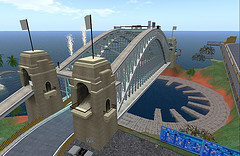
Reading about the ghost town effect, and having experienced it myself in eery lone visits to Australian landmarks, it’s clear that Second life could have done with a few more European-style urban planners or American new urbanists on the team. They would have pointed out that endless sprawl leads not to a feeling of spaciousness but to isolation. Second Life is effectively a lesson in the pitfalls of suburban sprawl taken to its dysfunctional conclusion. To enter Second Life is the online equivalent of moving from Boston or Seattle to Phoenix, Arizona, or from London to Adelaide. It isn’t that there are no people, just that the residents are spread out over an unfeasibly large area. The ghost town effect is a direct consequence of trying to abolish the scarcity of ‘land’. The saving grace here is that it is in fact already possible to do the opposite – to recreate online the super dense urban slum, that allows maximum, if not optimum, conviviality. Second Life already contains a reconstruction of Hong Kong’s famous and no longer existing Walled City – a city quarter that was in its heyday the densest spot on earth. In SL it’s mostly empty. But In a virtual environment one can have all the benefits of density – connection, liveliness, collaboration – with none of the pitfalls – open sewers and hacked power supplies. Now all that’s needed is to lead people to that kind of space by culling the suburbs. It may seem a bit harsh for those users who prefer to camp out on their exclusive islands in splendid isolation and have no visitors, but the commercial alternative for Second Life is Second Death. Fortunately, Linden Labs is already planning to introduce zoning. It’s a start.

Linking 3D with 2D

Having said that, the real problem with all these virtual spaces is Continue reading Linking Virtual Worlds

Ironies of the Netbook

The book is a relative newcomer in western society. It began its career in the mid-15th century and its future is no longer certain, threatened as it is by new inventions based on different principles.’

These words come from Lucien Fevre’s preface to The Coming of the Book, published in French in 1958.  I’m reading them sixty years later, sitting on a train using a portable computer, with the aid of a repository of electronically scanned volumes, which makes instantly available an unreadable number of published works, not to mention millions of pages of ‘unpublished’ electronic texts.

The irony of this situation is remarkable.

The book endures

The laptop is approx A4 size, the netbook is the size of a paperback.

The first irony is that the computer I am using is called a notebook. That is, conceptually the new invention is not ‘based on different principles’ but explicitly pays homage to the old, even as it radically undermines it. Now that the netbook craze is upon us, we are doing the same thing. The striking thing about the new cut-down mini-notebooks such as the Asus eee PC and now the Dell Inspiron 910 is that they are trying very hard indeed to be the same size and weight as a paperback book (remember that the paperback was the new reading technology of the 1930s). And we seem to be desperate to keep calling them books. As with the last major shift – from scroll to codex – it seems that while the technology may change, the name remains the same. If we call it a book, even though a netbook, does it remain one?

The scribes endure too

The scribal tradition has been reinvented with reCaptcha

The second irony is that mindful of legal considerations the electronic repository in question – Google Books – has artificially hobbled a piece of already existing technology that would effortlessly allow copying of the text. The result is that when I want to reproduce a quotation, as above, I need to copy it out by retyping it manually, letter for letter, word for word, in a manner strongly reminiscent of the working practices of the monastic scribes who dominated the book industry before the coming of the printing press, let alone the coming of the computer. Now, through the use of the reCAPTCHA security process, this activity of scribal rewriting has been massively distributed, so that every time someone spends ten seconds verifying they are human, they contribute to digitally transcribing the equivalent of one hundred and fifty printed books per day. (according to Luis Von Ahn of Carnegie-Mellon University).

Appearing to arrive

Third, it’s easy to overlook the ambiguity of the original French title. Translated as the ‘coming’ of the book, the original French word is ‘l’apparition’, which can equally be translated ‘appearance’ and which has a double meaning in both languages. Does the e-book you hold on your lap actually amount to a real book which has almost magically ‘arrived’ inside your computer, or does it only have the ‘appearance’ of a book?

So who’s imagining whom?

Is the netbook a book just because we say it’s a book? Perhaps, conversely, there is something so compelling about the concept of a book in our culture that it simply refuses to lie down and die, transmuting instead into something very different, but eerily the same. As James Wood says,

‘a good proportion of reality consists of what we freely imagine; and then, less happily perhaps, we discover that that reality has imagined us—that we are the vassals of our imaginings, not their emperors or archdukes.’

References

Lucien Febvre and Henri-Jean Martin, The Coming of the Book: 1450-1800. Trans. David Gerard. London: Verso, 1984)

James Wood, ‘The Unforgotten. Aleksandar Hemon’s fictional lives’. The New Yorker 28 July 2008 Accessed at http://www.newyorker.com/arts/critics/books/2008/07/28/080728crbo_books_wood?currentPage=all