There’s an interesting working paper on the culture of political blogs over at Crooked Timber.
Some highlights and discussion: Continue reading Political blogs – the curious case of the missing centre
There’s an interesting working paper on the culture of political blogs over at Crooked Timber.
Some highlights and discussion: Continue reading Political blogs – the curious case of the missing centre
 Most of the dominant analyses of society allow for a straight choice between one of only two conditions. A clear example is political preference, the dichotomy between ‘liberal’ and ‘conservative’ or between left and right. But the Four cultures approach explored on this website proposes that there are four, not two basic ways of organising society (but there aren’t any more than that). It claims that when we think in terms of only two ways of organising society, we are missing out on the other two, and then our understanding as well as our freedom of action suffers for it.
Since this post is being composed on Dr Seuss’s birthday, I’ll use an appropriate example: Green Eggs and Ham. Continue reading The Four Cultures – No Way! Oh go on then…
 As I write this on the train home, my neighbour is watching Star Wars: A New Hope on his portable DVD player. The bleeps and moans of R2D2 and Chewbacca come through clearly on his earphones. Thirty two years after its release, the movie and its myth-making are evidently still going strong. But what is it that gives this particular story its staying power?
I think it works partly because it recognises the existence of the Four Cultures and the endless conflicts and settlements between them.
Here’s how it works:
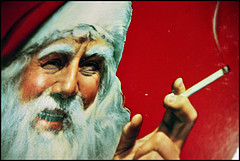 Marketing, whether of a product or an idea, can be overt or it can be covert.
In the former everyone can see what’s happening and can willingly consent to it. The latter, though can become out and out manipulation. Mostly, there’s a big grey area in between. Continue reading The Four Cultures of Marketing Ethics
As a genre, sci-fi is par excellence concerned with culture. What would it be like to visit an alien world? How would its inhabitants operate, and how would they differ from us?
In a way it’s a kind of theoretical anthropology. Think of Ursula Le Guin’s inquiry into a culture of hermaphrodites in The Left Hand of Darkness, or of Iain M. Banks’s series of novels in which he explores the political permutations of a culture that has abolished scarcity – a culture provocatively named ‘the Culture’. Continue reading The Four Cultures of Science Fiction
 Imagine a village nestled in a valley below a large dam.
One morning the villagers look up from their houses to see very clearly that the dam has suddenly burst and a huge quantity of flood water is incontrovertibly rushing down the valley towards the defenceless settlement.
It has all happened so fast there is no way of stopping it. And no-one is doubting the reality of the predicament: the village is about to be entirely consumed by the raging flood.
So far, so certain. The facts are there to be seen by all. So, given this, why doesn’t everyone do the same thing? Surely the best course of action is obvious.
The theory of Four Cultures suggests that even when the facts are clearly known, there are four main ways people interpret their environment. Continue reading The Dam Bursts
Nick Naylor: Right there, looking into Joey’s eyes, it all came back in a rush. Why I do what I do. Defending the defenseless, protecting the disenfranchised corporations that have been abandoned by their very own consumers: the logger, the sweatshop foreman, the oil driller, the land mine developer, the baby seal poacher…
Polly Bailey: Baby seal poacher?
Bobby Jay Bliss: Even *I* think that’s kind of cruel.— Thank You For Smoking (2005)
Grid-group cultural theory proposes that there’s a constant and endless argument going on about ‘the facts of the matter’. We look at the evidence that suits our cultural biases – moreover we create the evidence to fit our take on the world. Continue reading The Dark Side of Cultural Theory
 Is energy efficiency a key factor in reducing greenhouse emissions?
Matthew Taylor of the RSA thinks home energy efficiency should take priority, and Amory Lovins of the Rocky Mountain Institute is also very keen on large scale efficiency gains.
The Jevons Paradox is the idea formulated in 1865 that making coal-burning more efficient will lead inexorably to the burning of yet more coal. Newcomen’s steam engine dramatically increased the use of coal in England and William Jevons’ (1835-1882) book The Coal Question noted this. but Jevons also saw that James Watt’s more efficient version was what made coal-burning really take off, truly inaugurating the ‘age of steam’. He wrote: Continue reading Energy Efficiency: Running to stand still?
The director of the UK’s Soil Association, a peak organic farming body, has been in Australia talking about a new agenda for the organic movement.
There’s a chance to hear what Patrick Holden said on Radio National.
Patrick Holden in Sydney Feb 2009
The broadcast talk spoke of a ‘Rob Hopkins effect’ – referring to the impact on Holden’s thinking of the originator of the Transition movement – a grassroots push to plan for communities that will be more resilient in the face of the twin threats of peak oil and global warming.
Holden’s words are like a primer on the Egalitarian mode of understanding the world. He speaks of major threats to civilisation, of population size as a problem, of a need to change our values, not just our living arrangements. He extols the benefits of bottom-up, as opposed to top-down planning, and of localising the economy.
Towards the end he also speaks of the need for the organic movement to go beyond merely speaking to itself. And this is where the issue lies. How can an almost text-book Egalitarian agenda communicate beyond the self-imposed ghetto of Egalitarianism? Is there a way of talking outside the box of one’s own worldview?
Continue reading Talking outside the Box? – Patrick Holden on a new agenda for organic farming
The intensity and scale of the Victorian bush fires stuns the imagination. The photos of those killed are heartwrenching. For Australia this is an example of what Alain Badiou has called a ‘truth event’ – a moment prior to emotional or intellectual assimilation, an interpretative vacuum as yet unready to be filled with meaning or ideology.
Fires, of course, don’t speak, and they don’t deliver messages. To seek to understand what they say to us is inevitable, though, the start of a ‘truth process’. It is to come up against ‘the Real’, as Lacan put it.
For grid-group Cultural Theory, these kinds of events are a kind of ‘ground zero’ for the ongoing creation of meaning and organisation that is culture. Watch how quickly commentators now step into the breach and start to name the un-namable.
What, so far, is the message of the fires?
For Egalitarian scientist Tim Flannery , the message is obvious: global warming. For many politicians, the message is more traditional, if still Egalitarian: we must all pull through together, or not at all.
However, with fires at one end of the country and floods at the other, many Australians will, as ever, be filling the vacuum with a Fatalist message: nature is capricious. Keep your head down, make the best of it you can, and put the rest down to sheer luck.
 Four Cultures