How I learnt to stop worrying and love grid-group cultural theory

old-divinity-school-cambridgeFourcultures received a nice email from Huw asking how I learned about cultural theory. It was  while enrolled on a religious studies course that I first came across the work  of anthropologist Mary Douglas, who had developed a four part typology of cultures in her book Natural Symbols. Admittedly at the time it didn’t seem very clear how to apply this, since education is mostly wasted on the young. Intriguing as it was, I didn’t take it any further. But it must have been bubbling away under the surface because years later, while studying the phenomenon of peak oil, it suddenly struck home that the arguments for and against peak oil seemed to match very well the contours of cultural bias, or social solidarities,  that Douglas had sketched. On further investigation it became clear that the theory had been strongly developed since the 1980s and now has much to say about today’s social, political and religious debates. That’s what this website is about.

A definitive survey of Mary Douglas’s work was written by Richard Fardon: Mary Douglas: An Intellectual Biography (London: Routledge, 1999).

For those wanting to find out more about grid-group cultural theory and the four cultures it describes you could check out Michael Thompson’s book, Organising and Disorganising, which Huw says is great.

Michael Thompson gave a lecture at the RSA, and an interview which you can download.

[updated 4/2/2016]

Contingency Plans for Peak Oil

Should national governments make contingency plans in case of peaking oil? In a recent report of an interview he did with Fatih Birol, head of the IEA, the journalist George Monbiot appears shocked there is no such plan for the UK. Why?

In about 1973 you could collect three vouchers from the side of a cornflakes packet and send off for a little plastic model of a North Sea oil rig. For a child, this was the brave new frontier, the UK’s answer to the space program. It was exciting. And even then it was common knowledge we had ’30 years’ of oil so there was no need to worry about the future. Since then, we’ve always had ’30 years of oil’ because most policy makers saw this not as a prediction about reality but merely as code for ‘not on the policy radar, ever’. Then (after 30 years, note) North Sea oil began its steep and irreversable decline and policy makers were actually surprised.
Unfortunately for Reason with a capital R, humans don’t look at the facts and then decide what is going on. Instead we collect and filter data on the basis of preconceived notions of what must surely be going on. Egalitarians such as George Monbiot generally believe things must be running out and our options are narrowing. The by-line to the article says he was ‘shocked and alarmed’. He would be – it’s in the egalitarian job description. In contrast, Individualists are quite sure they know that there are limitless opportunities just waiting to be unlocked by human ingenuity and that all talk of scarcity is defeatist nonsense. Then there are the Hierarchists and the Fatalists who have their own take on the argument. These four poles are the four ‘cultural biases’ of grid-group cultural theory. An understanding of this goes a long way towards making sense of the way issues such as peak oil and global warming are such a lightning rod for debates about how society ought to be organised. A great primer on the basics of grid-group is Christopher Hood’s The Art of the State (1998), and the FourCultures blog looks at the world through a grid-group lens.
At the very least, this approach helps us recognise that we’re not really debating how much oil there is. We’re really promoting conflicting visions of social organisation, and using oil (or carbon dioxode, or whatever) as the pretext.

Evidence for the existence of Santa

i-love-santaInexplicably, one of the more popular search terms connected with this blog is ‘santa science’. Given the current season, perhaps this should be cleared up once and for all (look away now if you are under the age of 18):

There is no scientific evidence for the existence of Santa. However, this is not taught in schools, and teachers who do cast doubt in children’s minds are suitably punished (i.e. removed).

It may be true that every year the white bearded one is detected in North American airspace delivering presents by sleigh and given a welcome by fighter interceptor planes, but Youtube footage is unconvincing. Richard Dawkins, for one, has never received presents from Santa. He maintains this has nothing to do with his inability to be a good boy for a whole year, and it is difficult to argue that it might.

Here’s a nice piece of research on the issue of what children learn and unlearn about Santa.

Ironically, those who see something strange in society’s insistence on Santa’s literal truth are in the company of extreme Christian groups such as Jehovah’s Witnesses. These people hold that if children grow up disillusioned about what their parents told them regarding Santa, they’ll be less inclined to accept what they’re told about God. It’s hard to know whether this is correct because there is remarkably  little scientific research on the effects of Santa-belief, although ‘current research in developmental psychology suggests that even very young children competently draw boundaries between reality and its alternatives’ (Rosengren and Hickling, in Rosengren, Johnson and Harris, 2000: 76)

smoking-santaPerhaps it’s all a bit of harmless fun…

What do you think?

Please note: I made up the bit about Richard Dawkins.

Pirates: just acting rationally?

pirate sunset

Economist Peter Leeson has a new book coming out about the economics of piracy in the late 16th and early 17th century ‘golden age’. He uses piracy as a test case for the claim that rational choice economics is what motivates much of human behaviour. In an article on the same subject, he writes:

‘“Pirational choice” differs from rational choice only in that it deals with rationally self-interested decision making in the uniquely piratical context.’ (Leeson, 36)

The book has a great title, But is he right?

Continue reading Pirates: just acting rationally?

Climate change reporting and the ‘war on science’

icebergA couple of posts back I observed that though climate change denial is still a regular feature of the media, it tends to have been relegated these days to the ‘opinion’ section of the newspapers, rather than counting as ‘news’. It just goes to show I really haven’t been paying attention. So here’s an apology. I was wrong: denial of evidence for anthropogenic climate change is very much being reported as news. Today’s Australian newspaper, for instance, has a piece by John Stapleton entitled ‘Cold snap fails to cool protagonists of global warming

As it happens there are dozens of recent examples of climate change scepticism being presented either as one side of a balanced argument that has yet to be concluded, or else as the beleaguered voice of reason, remorselessly shouted down by climate change fanatics. The Australian piece falls into the latter category, as it reports media coverage of climate change as ‘hysterical’ and ‘getting worse’, ‘with a large public relations effort inundating the media with information from the alarmist side.’

Tim Lambert of UNSW has been cataloguing the ones he’s noticed, and is up to 24 from the Australian newspaper alone. He claims this amounts to a ‘war against science’. Is that right? Is it a war, and is science the true target?

Three questions about religious art for the Archbishop of Westminster

baptism-2

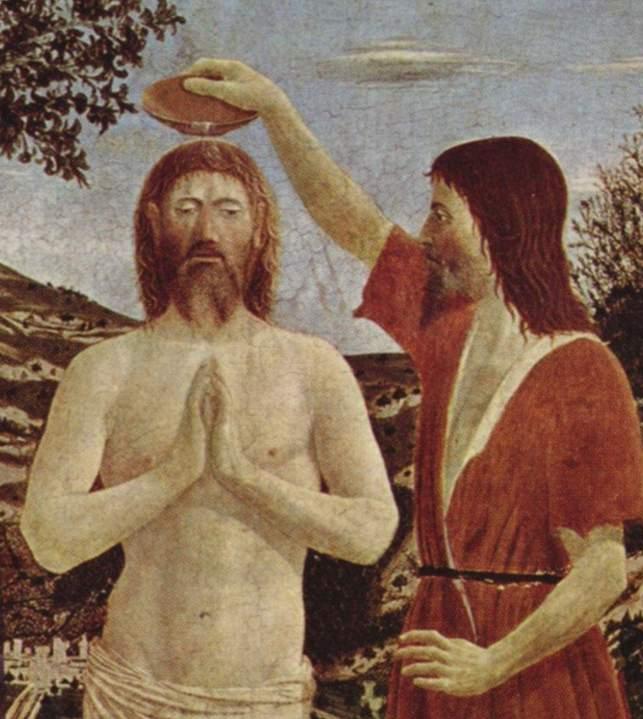
Should religious art be repatriated to churches and other places of worship?

According to Ruth Gledhill in the Times,

‘The Archbishop of Westminster, Cardinal Cormac Murphy-O’Connor, says that The Baptism of Christ, painted in the 1450s by Piero della Francesca, should be displayed in a religious setting such as Westminster Cathedral. In a lecture as part of the Royal Fine Art Commission Trust’s Roots of Faith lecture series supported by Sky Arts, at Emmanuel College, Cambridge, the Cardinal said: “I would like to see this painting taken down from the walls of the National Gallery and placed in a Catholic church in London because it is a mistake to treat it as a work of art: it is a work of faith and piety, an expression of the Church’s life and a way into prayer.”’

This is an interesting idea, but the choice of this particular painting to focus on begs a number of questions… Continue reading Three questions about religious art for the Archbishop of Westminster

Oh My God, they killed PoMo!!!

kennyA couple of days ago I finally noticed that I had missed a 2006 article by Alan Kirkby in Philosophy Now on the supposed death of postmodernism. Oh my God, they killed PoMo!!! I thought. Though admittedly, I had heard some fairly cruel rumours.

I Googled Alan Kirkby and went over to the full online text of the article, ‘The Death of Postmodernism and Beyond’ which I begin to read with great interest and here’s what I found…

Continue reading Oh My God, they killed PoMo!!!

Climate Change: is it a new religion?

Sydney Walk Against Warming 2008

The Murdoch rearguard action against climate change science just won’t die, although these days it tends to be confined to the opinion section of the newspapers, rather than counting as ‘news’. In today’s Sydney Telegraph, columnist Piers Ackerman gives another outing to his argument that climate change is natural (and, since you ask, probably isn’t happening anyway). He blames the state-run ABC media and the Fairfax press for perpetuating the myth. Which is slightly ironic, since in today’s Sydney Morning Herald (Fairfax owned) columnist Miranda Devine writes almost the same article excoriating the ‘church’ of climate change ‘fundamentalists’ and promoting the same climate sceptic, who happens to have a new book out this month, Adelaide University professor Ian Plimer.

Paralleling Devine’s use of religious metaphor, Ackerman sees climate change as a kind of ‘religion’, which is not to be questioned, and has its own orthodoxy and its own high priest in Al Gore.

This is hardly a new line of argument, and it still doesn’t look like dying away any time soon, so what’s going on here?

Continue reading Climate Change: is it a new religion?

Should we get out of the habit of worshiping anything?

“I want just to offer a few opinions, on the basis of no expertise whatever, for those who have already lost their religious beliefs, or who may be losing them, or fear that they will lose their beliefs, about how it is possible to live without God.

First, a warning: we had better beware of substitutes. It has often been noted that the greatest horrors of the twentieth century were perpetrated by regimes—Hitler’s Germany, Stalin’s Russia, Mao’s China—that while rejecting some or all of the teachings of religion, copied characteristics of religion at its worst: infallible leaders, sacred writings, mass rituals, the execution of apostates, and a sense of community that justified exterminating those outside the community.

When I was an undergraduate I knew a rabbi, Will Herberg, who worried about my lack of religious faith. He warned me that we must worship God, because otherwise we would start worshiping each other. He was right about the danger, but I would suggest a different cure: we should get out of the habit of worshiping anything.”

Stephen Weinberg, Without God The New York Review of Books
Volume 55, Number 14 · September 25, 2008
http://www.nybooks.com/articles/21800#fnr2

What to do when your Blog is bigger than Ben Hur

What should you do when your blog is too big to know your name?

In BusinessWeek, Sarah Lacy reports on how blogging multi-millionaire Jason Calacanis is ‘retiring’:
“Blogging is simply too big, too impersonal, and lacks the intimacy that drew me to it” he says.

It seems he’s turned to the timeless, homespun, traditional craft of hand-made…
Emails.

‘There is something about the acoustic, intimate nature of email that is impacting how I write,’ he says on his blog – even though he’s ‘retired’, ‘I’m writing every sentence as if I’m looking someone in the eye and speaking directly to them.’

Fortunately, this site will never be big or impersonal, and will always be packed full of intimacy. Unless someone wants to offer, say $25million. Jason will understand.

What about you? Do you prefer the small and the intimate, or the big and the brash? What do you come to a tiny site like this for anyway? As you post a comment, just remember I’m looking you in the eye and speaking directly to you right this moment.