A typology of disagreement

Clerks studying astronomy and geometry. France...
Image via Wikipedia

How are differences of opinion to be characterised?

That is to say, if there is more than one opinion, what is its status in relation to the others? Are there different types of difference of opinion? It’s hard to write about this matter because as soon as we do so we resort to language that is essentially metaphorical. These metaphors condition our thought and tend to beg the questions. So, for instance, to use the term conflicting opinions or competing opinions or incommensurable opinions is to assume that conflict, competition or incommensurability is a given. Of course, ‘opinion’ itself is a matter of opinion. One person’s opinion is another person’s fact. Even the term difference is somewhat metaphorical. What if it turns out our opinions don’t actually differ, after all? Perhaps by means of  Hegelian synthesis or some such trick, they can be reconciled to one another.

Michael Ruse, author of Science and Spirituality: Making Room for Faith in the Age of Science, has written about the ways in which we can characterise the debate between science and religion.  He identifies four approaches, namely:

  • Warfare
  • Independence
  • Dialogue
  • Integration

The contribution of this post is to suggest that these are not merely choices freely made but are pathways already prescribed by social circumstances. We can’t just wake up in the morning and decide that today the relationship between science and religion will be conflictual, and that tomorrow it will be dialogical. The social environment in which the relationship exists conditions to a large extent the way it is characterised. Our pre-existing assumptions and ways of organising make particular lines of reasoning seem ‘natural’ rather than ‘forced’. This point matters because of our tendency to see things as being ‘just the way they are’, without further reflection. If science and religion appear to be in conflict, we tend to jump straight to ontology (‘they just are in conflict – that’s how it really is’), without reflecting on our epistemology (‘how do we know how it really is?’). It is hard to see how the likes of Richard Dawkins and PZ Myers could stop being combative, or how the likes of the Catholic Church could stop trying to be all-encompassing. Notice that method and conclusion amount to the same thing.

The relationship between the four approaches identified by Prof Ruse can be clarified by means of Grid-Group Cultural Theory, under which rubric much thought has already gone into the cultural biases, or worldviews which shape our disagreements. Viewed in this context the religion/science debate tells us as much about the institutional framework of the debate as it does about the truth of the matter.

Approach     Metaphor     Typical institution       Cultural Bias

Warfare            Competition    the market                            Individualist

Independence Isolation          courtroom/prison              Fatalist

Dialogue          Consensus       deliberative democracy     Egalitarian

Integration     Nested Truth    bureaucracy                         Hierarchical

The dialogue approach is in the spirit of deliberative democracy, or of Jurgen Habermas’s communicative action.

The Integration approach is in keeping with Donald Davidson’s ideas expressed in his seminal article ‘On the very idea of a conceptual scheme’. Differences of opinion are subordinated to a hierarchical concept of Truth.

The independence approach is in keeping with Thomas Kuhn’s concept of separate paradigms, or the idea of separate (perhaps overlapping) magisteria.

Finally the warfare approach is closest to an understanding of knowledge as competition, with the survival of the fittest and ‘the marketplace of ideas’.

My suggestion is that these types of disagreement don’t just apply to the science and religion debate, but to all disagreements. Michael Ruse has successfully described the totality of parsimonious ways in which a disagreement may be characterised in any field. These relate closely to the ideal type worldviews or cultural biases of Cultural Theory. An interim conclusion is that while you can have any facts you like, your choice of difference of opinion is strictly limited (Prof Marco Verweij’s ‘constrained relativism‘ perhaps).

Equality and Hierarchy in Denmark

Hedeby
Hedeby, probable site of the first school in Denmark

Further reflections on the concept of horizontal and vertical teaching methods.

A recent edition of the journal Social Analysis (55.2, 2011) is entirely devoted to the contrast between hierarchical and egalitarian pressures on Danish Society.

The introduction begins with a discussion of the work of the anthropologist Marianne Gullestad (1946–2008). Gullestad developed a theory of Scandinavian social life based on the two dichotomies of hierarchy-equality and individualism-holism , which she derived from Louis Dumont (Dumont, Homo æqualis Paris: Gallimard, 1977). It continues:

“Our ethnographies suggest that simple dichotomies between egalitarianism and hierarchy or between individualism and holism do not hold.” (p.13)

One of the articles, by Karen Fog Olwig, focuses specifically on education in Danish kindergartens: ‘Children’s sociality: the ‘Civilizing’ Project in the Danish Kindergarten’.

These kinds of analysis would benefit from a consideration of the Cultural Theory typology in which besides hierarchical (vertical) and egalitarian (horizontal) approaches to education there are also Individualist and Fatalist institutional arrangements.

More generally, it’s possible to be suspicious of comparative national analyses which reify types of behaviour and then seek to apply them to national population groups, as though distinctive national characteristics were so easily demonstrated in this manner.

My concern here is that analyses which identify national characteristics do less to clarify those characteristics than they do to reinforce a kind of nationalist essentialism. This reassuring thought – that we’re doing the right thing when we organise along national lines – seems to me to have had its high point in the mid to late Nineteenth Century with the development of modern nation states, and then another peak after the Second World War with the rise of post-colonial independence movements. It is getting another airing in our time as part of a collective anxiety about globalisation. Most recently, the decline of European currency forces a rethink of national economic arrangements. The national is being renegotiated and redefined.

I’m arguing here that the process of identifying national characteristics is at least partly born from a certain cultural anxiety regarding national identities in an era of globalisation. So to argue that some nations have particularly ‘vertical’ teaching methods and that this impacts on governmental effectiveness, as do the authors of the study previously mentioned, reveals something about the context and preoccupations of the research itself. There is a market for clients (broadly construed) who are interested in reinforcing their ideas about the social reality, the solidity, of nation states.

Analyses inspired by the Cultural Theory approach of anthroplogist Mary Douglas instead start from the assumption that cultural differences are to be found as much within social groups as between them. That is to say, the cultural biases inherent in institutions operate at all scales, from the household (Gullestad’s ‘kitchen table society‘) to the global. This is not to deny the possibility of empirically observable national characteristics, but to contextualise them in a series of nested (Hierarchical), or competing (Individualist), or incompatible (Fatalist), or wholistic (Egalitarian) scales. An interest in identifying the dominant scale (natonal, supranational, something else?) reveals a Hierarchical cultural bias.

Where can Cultural Theory aid these kinds of investigation?

First, as mentioned, it identifies, parsimoniously, a further two ‘ideal types’, beyond ‘horizontal’ egalitarianism and ‘vertical’ hierarchy.

Second, it allows for a questioning of national characteristics as particularly national.

Third, following on from this, it renders visible contesting social forces within societies and institutions. So for example, where Hierarchical approaches to social organisation appear dominant, Cultural Theory can show how they may not be quite as dominant as seen at first sight (because they fit within a dynamic of contested worldviews), and it can show where the possibilities of change lie in already existing institutions and relationships.

To end on the idea of anxiety about national identity in an era of globaliisation, two books are particularly helpful on this:

David Held and Henrietta L. Moore, eds (2008) Cultural Politics in a Global Age: Uncertainty, Solidarity and Innovation. Oxford: Oneworld.

 Henrietta L. Moore (2011) Still Life: Hopes, Desires and Satisfactions. Cambridge: Polity.

References

Bruun, Maja Hojer; Jakobsen, Gry Skrædderdal; Krøijer, Stine (2011) Introduction: The Concern for Sociality—Practising Equality and Hierarchy in Denmark, Social Analysis, Volume 55, Number 2, Summer, pp. 1-19. [http://dx.doi.org/10.3167/sa.2011.550201]

Louis Dumont (1977) Homo æqualis Paris: Gallimard.

Four types of institutional control

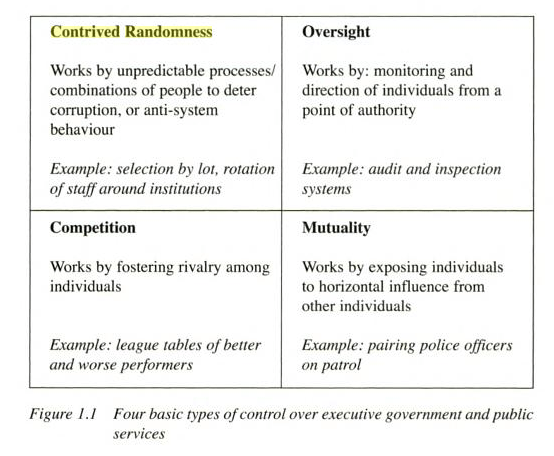
This diagram comes from a book edited by Christopher Hood (et al.) It shows how contrived randomness can be seen as a method of social control in public institutions (Hood et al. 2004:8).

As mentioned in a Fourcultures post on how to beat the odds and escape your fate, Hood wrote:

“Contrived randomness denotes control of individuals… by more or less deliberately making their lives unpredictable in some way”.

Hood et al., eds (2004) Controlling Modern Government. Variety, Commonality and Change. Cheltenham: Edward Elgar Press. p.8.

And as eagle-eyed readers of Fourcultures will observe, this scheme of control is modeled closely on the wider typology of grid-group cultural theory. You can compare the diagram above with this diagram of Cultural Theory to note the consistency.

Mutuality – Egalitarian
Oversight – Hierarchical
Competition – Individualist
Contrived Randomness – Fatalist

I’m interested in Hood’s work because he is one of the few proponents of Cultural Theory who recognize the salience of what may be termed Fatalist Activism – the idea that the Fatalist cultural bias is just as active as the other three biases and constantly seeks to shape our institutions.

This work is very useful for understanding all kinds of social contexts and institutional arrangements. Fourcultures has previously shown how the four cultural biases can be marshalled to develop a fourfold typology of educational equity. Hood et al.’s four types of control can be added to this kind of analysis. In the next post I’ll show how Cultural Theory and especially the concept of fatalist activism is highly relevant for the specific case of public policy on gambling.

How to beat the odds and escape your fate

This lottery ticket might promise luck but it's entirely predictable

We hate it when things that are supposed to be random actually turn out not to be. But on reflection it’s not quite that simple. We like random events to be random in entirely predictable ways. The ‘Fatalism’ quadrant of Grid-Group Cultural Theory includes random activity as a key aspect of social organisation. But it is contrived randomness that is sought – a term coined by professor of government, Christopher Hood:

“Contrived randomness denotes control of individuals… by more or less deliberately making their lives unpredictable in some way”.
Hood et al., eds (2004) Controlling Modern Government. Variety, Commonality and Change. Cheltenham: Edward Elgar Press.

Jonah Lehrer (author of The Decisive Moment, previously mentioned at Fourcultures) has a fine article in Wired about how to beat the scratchies. Two ideas stand out.

First, there is a strong sense that we know what kind of randomness to expect when we buy a scratch card. We are really buying into an almost Platonic ideal of randomness that is somehow, we feel, built into the universe. When Mohan Srivastava, a Canadian statistician, notices this is bogus we somehow want the scratch card manufacturers to improve their game and make the tickets really and truly random. We’re happy to be cheated by the goddess of Fortune, but emphatically not by mere mortals. This ideal of luck is very powerful – and very deceptive.

Second, the tenor of the article is that the world of lottery scratch cards isn’t really random at all. Lehrer implies suggests that there is an underworld of crooks who are tricking us out of our randomness fantasy by gaming the system to launder their drug money. Lehrer quotes Srivastava, the statistician who first spotted the flaw in the scratch cards:

“if there were people who could sort the winners from the losers, then what you’d see on the payout statistics is exactly what we see. This is what a plundered game looks like.”

In fact everywhere except in the Fatalism quadrant of Cultural Theory there is a strong bias against the idea of luck. Wired Magazine, we may hazard, does not have a readership of Fatalists. Rather the core demographic is competitive, innovative Individualism. You can imagine them (us?) nodding sagely in agreement when reading Mohan Srivastava’s reason for not making money out of the scratchies:

“to be honest, I make more as a consultant, and I find consulting to be a lot more interesting than scratch lottery tickets.” [note the link to a pay comparison site – this is the stuff Individualism is made of].

What  Srivastava says about the scratch card industry is also true, it is held, for life in general:

“The game can’t be truly random. Instead, it has to generate the illusion of randomness while actually being carefully determined.”

It turns out that the best way to beat the fickle finger of Fate is to refuse to believe in it at all.


Now read:

How to be a Fatalist

Fatalist policy in action

Fatalism in America today

Tempting Fate in schools

Half the cheese or double the cheese? Why not have both?

Health experts warn against the excessive consumption of saturated fats. At the same time industry marketing groups come up with novel campaigns to increase consumption. The role of government, often, is to mediate between these two contrasting positions.

The New York Times reports on a great example in which the same government department promotes cheese consumption and at the same time sends out messages against cheese consumption.

This would appear non-sensical or counter-productive. But from the perspective of a Hierarchical bureaucracy there isn’t really a contradiction. After all, cheese consumption has been promoted in both directions. The more promotion the better, surely…

In some respects this is similar to what government does with tobacco: warn against it but take the tax revenue.

See: The four cultures of marketing ethics

BP Oil Spill – why we care

A beach after an oil spill.
Image via Wikipedia

Behavioural psychologist Dan Ariely’s interesting website has a question about why we seem to care so much about the Gulf of Mexico oil spill, when we don’t seem to care as much about other big environmental disasters such as the ongoing destruction of the Amazonian rainforest.

Some good points are raised, including some fairly obvious ones

  • the Gulf is nearer to the US,
  • there was a definite starting point for the oil spill,
  • there are clearly defined bad guys,
  • etc.

All of these kinds of explanation lend themselves very well to analysis on the basis of bounded rationality – we make use of cognitive biases to organise ourselves and these biases aren’t very rational, or are rational only in a limited way. For example, it is somewhat rational to be concerned about environmental problems close to home, but it would be more rational (if that’s possible) to be concerned also about distant problems since they may still have a local impact. Indeed, even for a resident of Louisiana it’s possible that the destruction of the Amazon could be more significant than the oil spill – not in terms of column inches perhaps but in many other ways.

But here I want to put concern about the oil spill in anthropological context and suggest it’s about pollution. Continue reading BP Oil Spill – why we care

It’s OK if you don’t know everything

“We rarely know an explicit formula that tells us what to do in a complex situation. We have to work out what to do by thinking through the possibilities in ways that are simultaneously imaginative and realistic, and not less imaginative when more realistic. Knowledge, far from limiting imagination, enables it to serve its central function.”

“Sometimes the only honest response to a question is “I don’t know.” In recognizing that, one may rely just as much on imagination, because one needs it to determine that several competing hypotheses are equally compatible with one’s evidence.”
– Timothy Williamson, Reclaiming the Imagination

It’s OK if you don’t know everything…

Now read: how do we know what we think we know?

L’analyse culturelle de Mary Douglas

– une contribution à la sociologie des institutions.

Here’s a good summary of Mary Douglas‘s Cultural Theory written in French (with an English abstract). It was published in SociologieS in 2006.

Marcel Calvez, « L’analyse culturelle de Mary Douglas : une contribution à la sociologie des institutions », SociologieS [En ligne], Théories et recherches, mis en ligne le 22 octobre 2006, Consulté le 07 septembre 2010. URL : http://sociologies.revues.org/index522.html

A Cultural Theory of Cricket?

Bat & Ball Inn near Hambledon Cricket Club, CC via WikipediaFascinating uses of Mary Douglas’s cultural theory pop up every so often.  The latest relates to the venerable game of cricket.

The hypothesis of cricket blogger downatthirdman is that as the culture of the English downlands shifted from strong grid – strong group Hierarchy towards a weaker grid- weaker group Individualism in the Eighteenth century, so the game of cricket became an ideal carrier of the new values.

Cricket’s mix of team work, rule formalism and recognition of individual prowess (earned status as opposed to ascribed status) was exactly suited for the times. It’s certainly an interesting idea.

“As the requirements of the social structure changed so the culture responded in the type of rituals (including games) needed to reinforce the system. Cricket with its mixture of team work and individualism exactly met the need. Its time had come.”

You can read more at Chalk and cheese: towards a cultural theory of cricket.

And there’s a second instalment here, with some great pictures: The cradle of cricket was an old fashioned car boot sale.

Given the recent match fixing scandal that has engulfed international cricket in recent weeks I can’t help wondering whether a similar analysis could be made of the current situation.  One way of looking at corruption in professional sport might be to see it as an over-emphasis on competitive Individualism, in which rule-following is a hindrance to financial success and the winners are the ones who get away with it.

Cultural Theory and the Open Society

Catriona Kelly, Professor of Russian at Oxford Universty, has written an article about the concept of freedom in the context of Soviet and post-Soviet politics. She takes issue with the two-sidedness that pits the open society against the closed society, finding in Grid-Group Cultural Theory a helpful and illuminating alternative.

”The “open society” to which Soviet existence is often claimed to have been opposed resembles the old idea of “the free world”. A non-moralistic approach to group relations in the Soviet Union moves beyond the simplistic link between modernisation and openness”

Of Grids and Groups

The Open Society?Photo credit: Flickr/stephenpace