The meaning of culture

When Glasgow won the honour of hosting the 1990 European City of Culture festival the joke was, Culture? Isn’t that what we’ve got growing on our walls? (from memory,  this was Rab C Nesbitt’s contribution). It wasn’t far off the mark though. I interviewed an amazing woman, Cathy McCormack, who had successfully campaigned for a medical and, yes, cultural recognition that the mould growing in council houses was a contributing factor to Glasgow’s high incidence of heart disease, and that therefore, it shouldn’t be assumed that people with heart disease had brought it upon themselves by eating a poor diet (deep fried mars bars and pizzas notwithstanding).

So culture can mean different things depending on context. I rather like Edgar Schein’s description (1991: 111):

‘Culture can now be defined as a pattern of basic assumptions, invented, discovered, or developed by a given group, as it learns to cope with its problems of external adaptation and internal integration, that has worked well enough to be considered valid and, therefore is to be taught to new members as the correct way to perceive, think, and feel in relation to those problems’.

That’s certainly neat, but it’s not necessarily straightforward. I’ve previously mentioned here the meaning of culture, and it should be noted that a well-known study by Kroeber and Kluckhohn (1963) identified 164 unique definitions of the term ‘culture’, while van der Post et al. (1997) listed more than 100 dimensions and according to Ott (1989) there were 74 elements of organisational culture. Continue reading The meaning of culture

Is Grid-Group cultural theory really a theory?

It was a trick of course. Yesterday I used Grid-Group cultural theory to ‘predict’ the Fatalist viewpoint of Nicholas Taleb, author of The Black Swan. But like the magician who successfully predicted the lottery numbers, it’s more about sleight of hand than about actual magic…

Despite the name, cultural theory isn’t really a theory at all. It’s a conceptual scheme – an heuristic we use, it might be argued, because we are cognitive misers and like making short cuts in our thinking. The world is big and hard to understand, so we make biased assumptions about what ‘usually’ happens, what ‘must’ happen, or what ‘really’ happens, what ‘the facts of the matter’ are, and so on. (to give just one example from millions, some more, some less trivial: Nick Cave’s deep-voiced assertion, ‘People they ain’t no good’). Moreover, we don’t just get these ideas out of our own heads somehow. They are embodied in the institutions in which we participate, from the family mealtime to the Copenhagen Climate summit, so that they are accounts of actual reality as we experience it. They really do explain how the world is – at least parts of it – so that our ideas seem like common sense. It is argued that these cultural biases or cultural solidarities coalesce into four basic ‘ideal types’, the four cultures for Grid-Group Cultural theory. But can we actually measure this? And can we really use the result to predict anything? Continue reading Is Grid-Group cultural theory really a theory?

I’ll have four of everything

So many four-fold conceptual schemes, so little time… The following three appear arbitary, contrived, as though arranging a subject matter in groups of four was in itself clever (and just to complete my own set of four, here’s one I wrote about earlier).

Manuel Castells’ (2001) four cultures of the internet:

* Academics
* Open source advocates
* Social communities
* Entrepreneurs

Also Dennis Mumby’s four kinds of discourse, producing narratives of:

* Representation (positivist modernism)
* Understanding (interpretive modernism)
* Suspicion (critical modernism)
* Vulnerability (postmodernism)

And the ‘four cultures of the West’ described by church historian John O’Malley (2004):

* prophetic
* academic
* humanistic
* artistic

Perhaps it’s just that five would be too many and three too few.

References
Manuel Castells (2001) The Internet Galaxy. Reflections on the Internet, Business and Society. Oxford, Oxford University Press.

Dennis K Mumby (1997). Modernism, postmodernism, and communication studies: A rereading of an ongoing
debate. Communication Theory, 7, 1–28.

John W. O’Malley 2004 The Four Cultures of the West. Cambridge, Massachusetts: The Belknap Press of Harvard University Press.

Now read: Mapping Four-fold conceptual schemes

How do we know what we think we know? (part 2)

How do we know the tide won’t wash the beach away?

A couple of years ago a local newspaper reported a certain beach-front resident claiming  “It’s ridiculous to think this beach would ever get washed away by a king tide. I’ve lived here four months and it’s just never happened.” This is an example of an heuristic in operation. The particular heuristic the resident used was this: anything that hasn’t happened within the last four months will never happen. Clearly, it’s a deficient way of thinking (parts of the beach have in fact been washed away), but might there be heuristics that, though not infallible, are useful?

This post follows on from one a while back about how we know what we think we know about ‘how things really are.’ I’m seeking to develop a way of characterising grid-group cultural theory as a set of four ecologically efficient social learning heuristics.

Given that we don’t actually know how stable the beach is, or indeed anything much about how things really are:

We use heuristics… Continue reading How do we know what we think we know? (part 2)

Virtual Goods and the Greatest Story ever Told


Virtual goods make money

In a recent post about the profitability of online social networks in the US, China and Japan, venture capitalist Bill Gurley presents evidence that the more financially successful social network sites are those that downplay advertising revenue and focus on revenue from virtual goods. He points out that Users in Second Life are doing $450m annually in this business and taking out of Second Life $100m a year.

But why would anyone buy them? Continue reading Virtual Goods and the Greatest Story ever Told

How do we know what we think we know? What the Density Classification Problem tells us

How can we know what the world is really like?

We often hear fairly frank opinions about how things ‘really’ are. We probably make these kinds of claims ourselves from time to time: ‘the fact is…’, ‘that’s just the way it is…’;  ‘you know what it’s like…’

But how do we know what we think we know? And what makes us so sure that our assumptions are right?

Continue reading How do we know what we think we know? What the Density Classification Problem tells us

The Dam Bursts

credit: mandj98Imagine a village nestled in a valley below a large dam.

One morning the villagers look up from their houses to see very clearly that the dam has suddenly burst and a huge quantity of flood water is incontrovertibly rushing down the valley towards the defenceless settlement.

It has all happened so fast there is no way of stopping it. And no-one is doubting the reality of the predicament: the village is about to be entirely consumed by the raging flood.

So far, so certain. The facts are there to be seen by all. So, given this, why doesn’t everyone do the same thing? Surely the best course of action is obvious.

The theory of Four Cultures suggests that even when the facts are clearly known, there are four main ways people interpret their environment. Continue reading The Dam Bursts

Evidence for the existence of Santa

i-love-santaInexplicably, one of the more popular search terms connected with this blog is ‘santa science’. Given the current season, perhaps this should be cleared up once and for all (look away now if you are under the age of 18):

There is no scientific evidence for the existence of Santa. However, this is not taught in schools, and teachers who do cast doubt in children’s minds are suitably punished (i.e. removed).

It may be true that every year the white bearded one is detected in North American airspace delivering presents by sleigh and given a welcome by fighter interceptor planes, but Youtube footage is unconvincing. Richard Dawkins, for one, has never received presents from Santa. He maintains this has nothing to do with his inability to be a good boy for a whole year, and it is difficult to argue that it might.

Here’s a nice piece of research on the issue of what children learn and unlearn about Santa.

Ironically, those who see something strange in society’s insistence on Santa’s literal truth are in the company of extreme Christian groups such as Jehovah’s Witnesses. These people hold that if children grow up disillusioned about what their parents told them regarding Santa, they’ll be less inclined to accept what they’re told about God. It’s hard to know whether this is correct because there is remarkably  little scientific research on the effects of Santa-belief, although ‘current research in developmental psychology suggests that even very young children competently draw boundaries between reality and its alternatives’ (Rosengren and Hickling, in Rosengren, Johnson and Harris, 2000: 76)

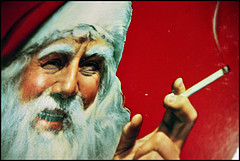
smoking-santaPerhaps it’s all a bit of harmless fun…

What do you think?

Please note: I made up the bit about Richard Dawkins.

Can hierarchical thinking fix climate change?

A recent article about business responses to global warming highlights the extent to which hierarchical thinking can respond adequately to rapid changes in the climate. 

And it neatly illustrates the preoccupations of a hierarchical world-view, as understood by grid-group cultural theory.

The article, written by Leon Gettler, centres on the increasing role of ‘Chief Carbon Officer’ in businesses. 

‘The job of the future will be the chief carbon officer, or CCO. That’s because global warming is no longer an environmental issue.’

The author sees not only the CCO, but also new job titles like Director of Sustainability Strategy as ‘just the beginning’.

According to grid-group cultural theory, first established by anthropologist Mary Douglas, and expanded by numerous writers in several different disciplines, there are four fundamental world-views, related to social group strength and rule maintenance. The hierarchist position is ‘strong grid, strong group’. In other words it is both highly group-orientated and highly regulated. For this way of thinking, the crisis (any crisis) is less about external factors and more about who is in charge, and how the social structure is to be maintained. Continue reading Can hierarchical thinking fix climate change?