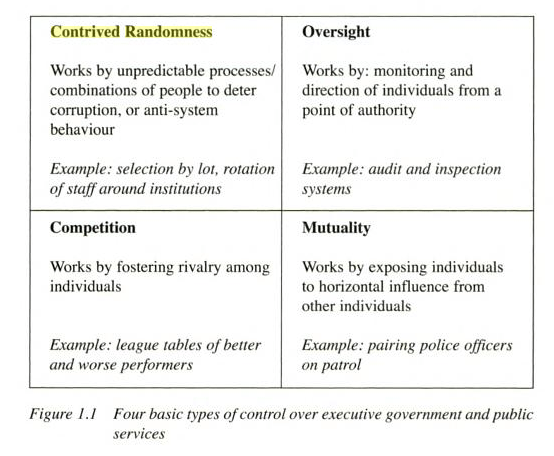
Four types of institutional control

This diagram comes from a book edited by Christopher Hood (et al.) It shows how contrived randomness can be seen as a method of social control in public institutions (Hood et al. 2004:8).

As mentioned in a Fourcultures post on how to beat the odds and escape your fate, Hood wrote:

“Contrived randomness denotes control of individuals… by more or less deliberately making their lives unpredictable in some way”.

Hood et al., eds (2004) Controlling Modern Government. Variety, Commonality and Change. Cheltenham: Edward Elgar Press. p.8.

And as eagle-eyed readers of Fourcultures will observe, this scheme of control is modeled closely on the wider typology of grid-group cultural theory. You can compare the diagram above with this diagram of Cultural Theory to note the consistency.

Mutuality – Egalitarian
Oversight – Hierarchical
Competition – Individualist
Contrived Randomness – Fatalist

I’m interested in Hood’s work because he is one of the few proponents of Cultural Theory who recognize the salience of what may be termed Fatalist Activism – the idea that the Fatalist cultural bias is just as active as the other three biases and constantly seeks to shape our institutions.

This work is very useful for understanding all kinds of social contexts and institutional arrangements. Fourcultures has previously shown how the four cultural biases can be marshalled to develop a fourfold typology of educational equity. Hood et al.’s four types of control can be added to this kind of analysis. In the next post I’ll show how Cultural Theory and especially the concept of fatalist activism is highly relevant for the specific case of public policy on gambling.

How to beat the odds and escape your fate

This lottery ticket might promise luck but it's entirely predictable

We hate it when things that are supposed to be random actually turn out not to be. But on reflection it’s not quite that simple. We like random events to be random in entirely predictable ways. The ‘Fatalism’ quadrant of Grid-Group Cultural Theory includes random activity as a key aspect of social organisation. But it is contrived randomness that is sought – a term coined by professor of government, Christopher Hood:

“Contrived randomness denotes control of individuals… by more or less deliberately making their lives unpredictable in some way”.
Hood et al., eds (2004) Controlling Modern Government. Variety, Commonality and Change. Cheltenham: Edward Elgar Press.

Jonah Lehrer (author of The Decisive Moment, previously mentioned at Fourcultures) has a fine article in Wired about how to beat the scratchies. Two ideas stand out.

First, there is a strong sense that we know what kind of randomness to expect when we buy a scratch card. We are really buying into an almost Platonic ideal of randomness that is somehow, we feel, built into the universe. When Mohan Srivastava, a Canadian statistician, notices this is bogus we somehow want the scratch card manufacturers to improve their game and make the tickets really and truly random. We’re happy to be cheated by the goddess of Fortune, but emphatically not by mere mortals. This ideal of luck is very powerful – and very deceptive.

Second, the tenor of the article is that the world of lottery scratch cards isn’t really random at all. Lehrer implies suggests that there is an underworld of crooks who are tricking us out of our randomness fantasy by gaming the system to launder their drug money. Lehrer quotes Srivastava, the statistician who first spotted the flaw in the scratch cards:

“if there were people who could sort the winners from the losers, then what you’d see on the payout statistics is exactly what we see. This is what a plundered game looks like.”

In fact everywhere except in the Fatalism quadrant of Cultural Theory there is a strong bias against the idea of luck. Wired Magazine, we may hazard, does not have a readership of Fatalists. Rather the core demographic is competitive, innovative Individualism. You can imagine them (us?) nodding sagely in agreement when reading Mohan Srivastava’s reason for not making money out of the scratchies:

“to be honest, I make more as a consultant, and I find consulting to be a lot more interesting than scratch lottery tickets.” [note the link to a pay comparison site – this is the stuff Individualism is made of].

What  Srivastava says about the scratch card industry is also true, it is held, for life in general:

“The game can’t be truly random. Instead, it has to generate the illusion of randomness while actually being carefully determined.”

It turns out that the best way to beat the fickle finger of Fate is to refuse to believe in it at all.


Now read:

How to be a Fatalist

Fatalist policy in action

Fatalism in America today

Tempting Fate in schools

2010 in review

Happy New Year and thanks for reading the fourcultures website  in 2010.

The stats helper monkeys at WordPress.com mulled over how fourcultures did in 2010, and here’s a high level summary of its overall blog health:

Healthy blog!

The Blog-Health-o-Meter™ reads Wow.

Crunchy numbers

Featured image

The average container ship can carry about 4,500 containers. This blog was viewed about 18,000 times in 2010. If each view were a shipping container, your blog would have filled about 4 fully loaded ships.


In 2010, there were 49 new posts, growing the total archive of this blog to 223 posts. There were 6 pictures uploaded, taking up a total of 1mb.

The busiest day of the year was January 6th with 343 views. The most popular post that day was Expanders, Restrainers, Managers and Shruggers.

Where did they come from?

The top referring sites in 2010 were en.wikipedia.org, en.wordpress.com, matthewtaylorsblog.com, google.com, and culturalcognition.net.

Some visitors came searching, mostly for patrick heron, patrick heron paintings, culture of discipline, climate change jokes, and patrick heron artist.

Attractions in 2010

These are the posts and pages that got the most views in 2010.

1

Expanders, Restrainers, Managers and Shruggers January 2010
3 comments

2

Post-Secular Artist? Nine Reflections on the Art of Patrick Heron September 2008
1 comment

3

The Google Dilemma. National Differences and Cross-Cultural Theory February 2010
3 comments

4

A short summary of grid-group cultural theory March 2010
1 comment

5

The decline of civilization – sudden or gradual? April 2010
1 comment

Half the cheese or double the cheese? Why not have both?

Health experts warn against the excessive consumption of saturated fats. At the same time industry marketing groups come up with novel campaigns to increase consumption. The role of government, often, is to mediate between these two contrasting positions.

The New York Times reports on a great example in which the same government department promotes cheese consumption and at the same time sends out messages against cheese consumption.

This would appear non-sensical or counter-productive. But from the perspective of a Hierarchical bureaucracy there isn’t really a contradiction. After all, cheese consumption has been promoted in both directions. The more promotion the better, surely…

In some respects this is similar to what government does with tobacco: warn against it but take the tax revenue.

See: The four cultures of marketing ethics

Twitter, Facebook, and social activism: newyorker.com

Twitter, Facebook, and social activism: newyorker.com.

This article by Malcolm Gladwell makes a useful distinction between strong ties activism and weak ties activism. The former was always possible, the latter only really viable with the coming of the social web. Activists with strong ties have real, face to face friends. Online activism has to make do with the weak ties of friends on Facebook. Gladwell disparages weak ties activism as, effectively, activism for people who can’t be bothered to actually do it. He claims that rumours of the Twitter revolution in places like Iran have been greatly exaggerated.

I’d agree about the exaggeration. One cause of this which he doesn’t mention is the incentive journalists and editors have to add current buzzwords to well-established reporting tropes. Thus for example ‘crack addicts stole my iPad’ breathes new life into an otherwise dying formula. In the case of civil unrest in far-flung nations there is a great temptation to add the words Facebook or Twitter to the headline.I’d also agree that weak ties are, well, weak. There’s a danger of them being expected to accomplish more than they can reasonably be expected to.

Much of what passes as media comment on internet activism is little more than star-struck boosterism. But I think Gladwell is a little too negative about the potential for the social web to ‘change the world’. There are two areas in particular where worthwhile things seem to be happening.

First, in the area of activism, organisations like GetUp in Australia and Moveon in the US have had a fairly large impact on the political landscape. Certainly GetUp has filled a gap that would otherwise not have been filled in engaging dynamically with political issues and making it possible for groups of people to do things they never could have done prior to Web 2.0. For instance it is now common for GetUp to run political TV ads in prime time, flash-funded by its members all chipping in small amounts of cash to create a big effect. These microdonors don’t need to be best buddies with one another. They don’t need strong ties. They just need to be able to leverage the aggregated power their web-enabled weak ties give them. Weak ties do some political things very well. Interestingly these weak ties can also lead to the strengthening of strong ties. There is a deliberate strategy of encouraging local face to face meet ups, and it was claimed that before the last federal election 1 in 30 residents of Canberra, the national capital, was a GetUp member.

This brings us to the second way the social web can reasonably claim to be  changing the world. This is the use of weak ties to connect otherwise disconnected people to make practical differences collectively. Micro-credit organisations such as Kiva are linking lenders and borrowers in mutually beneficial ways and thus empowering the otherwise disempowered. The Ushahidi mapping platform is being used to monitor elections in Egypt, Brazil and Venezuela.  In these ways the social web helps committed people to do their activist work more effectively. Erik Hersman, the organisation’s operations director, says:

I don’t see too many governments being displaced or replaced by online cooperation alone. Trust, reputation and resources are just a few of the hurdles to overcome before that happens. Instead, I think we’re seeing the continuation of the refinement of mass movements, brought about by the inefficiencies in the system, which catch on faster and are enabled better online and then move offline for impact.

My own guess is that these new kinds of social movement and the new kinds of public association – enabled by internet and mobile phone technology –  are going to become ever more important. If this is so, the current views of Malcolm Gladwell may come to look an awful lot like the second stage of the time-honoured  method of assimilating ideas whose time has come. To paraphrase the trade unionist Nicholas Klein:

First they ignore you, then they ridicule you, then they fight you, then you win.

BP Oil Spill – why we care

A beach after an oil spill.
Image via Wikipedia

Behavioural psychologist Dan Ariely’s interesting website has a question about why we seem to care so much about the Gulf of Mexico oil spill, when we don’t seem to care as much about other big environmental disasters such as the ongoing destruction of the Amazonian rainforest.

Some good points are raised, including some fairly obvious ones

  • the Gulf is nearer to the US,
  • there was a definite starting point for the oil spill,
  • there are clearly defined bad guys,
  • etc.

All of these kinds of explanation lend themselves very well to analysis on the basis of bounded rationality – we make use of cognitive biases to organise ourselves and these biases aren’t very rational, or are rational only in a limited way. For example, it is somewhat rational to be concerned about environmental problems close to home, but it would be more rational (if that’s possible) to be concerned also about distant problems since they may still have a local impact. Indeed, even for a resident of Louisiana it’s possible that the destruction of the Amazon could be more significant than the oil spill – not in terms of column inches perhaps but in many other ways.

But here I want to put concern about the oil spill in anthropological context and suggest it’s about pollution. Continue reading BP Oil Spill – why we care

It’s OK if you don’t know everything

“We rarely know an explicit formula that tells us what to do in a complex situation. We have to work out what to do by thinking through the possibilities in ways that are simultaneously imaginative and realistic, and not less imaginative when more realistic. Knowledge, far from limiting imagination, enables it to serve its central function.”

“Sometimes the only honest response to a question is “I don’t know.” In recognizing that, one may rely just as much on imagination, because one needs it to determine that several competing hypotheses are equally compatible with one’s evidence.”
– Timothy Williamson, Reclaiming the Imagination

It’s OK if you don’t know everything…

Now read: how do we know what we think we know?

L’analyse culturelle de Mary Douglas

– une contribution à la sociologie des institutions.

Here’s a good summary of Mary Douglas‘s Cultural Theory written in French (with an English abstract). It was published in SociologieS in 2006.

Marcel Calvez, « L’analyse culturelle de Mary Douglas : une contribution à la sociologie des institutions », SociologieS [En ligne], Théories et recherches, mis en ligne le 22 octobre 2006, Consulté le 07 septembre 2010. URL : http://sociologies.revues.org/index522.html

Is God a blank slate?

chicken egg and hand
Image via Wikipedia

Dan Ariely, behavioural psychologist, reports on research that concludes that we select our view of God’s opinions to fit with our own. It seems that as our own opinions change so does our description of God’s opinions. The conclusion then is that God is a blank slate, onto which we project our opinions.

“Overall these results suggest that God is a blank slate onto which we project whatever we choose to. We join religious communities that argue for our viewpoint and we interpret religious readings to support our personal positions.”

You can read more at Creating God in our own image.

It’s a great research project, but the trouble with such conclusions is that personal opinions tend to suffer from chicken and egg syndrome. Which came first, the opinion or the opinion-holder?

Methodological individualism tends to isolate the individual from outside influences. On this model the opinion-holder is prior and somehow selects their opinions from some kind of smorgasbord of opinions. The opposite view seems more explanatory of people’s religious views: we are born into communities of opinion and our communities shape us in their image. We can, for sure, dissent, but then we are dissenters.

Americans tend to see religion as a choice, but this is unsurprising since that country has more religions than any other. American culture almost forbids a view of  religious affiliation as determined – and this is one of its determining features.  I don’t just have opinions: I was given them by my environment.The environment given – mandated –  by America is one of religious choice.

But I didn’t just come up with my views on xyz out of thin air. Rather I was educated, raised, trained, tutored. Heck, I even learnt a few things for myself by means of life experience. In other words there’s no such thing as me independently of my God-concept. There is only a me-God nexus and we mutually reinforce one another’s understanding of the world.

The locus of concepts such as God isn’t entirely within the individual but is supra-individual or trans-individual. I don’t deny the import of the research referred to. I recently re-read Anne Lamott’s great line in Bird by Bird:

“You can safely assume that you’ve created God in your own image, when it turns out that God hates all the same people you do.”

However, it’s reasonable to be sceptical of the  assumption that whereas God is supposedly a blank slate, we ourselves are not and never have been. There’s a clue in the title of Prof Ariely’s blog post, creating God in our own image: we collectively (somehow) create God in our own image.

We’re in it together, or as Hilary Clinton never said, it takes a village to raise a deity.

The original research, by Nicholas Epley, Benjamin Converse, Alexa Delbosc, George Monteleone and John Cacioppo, is here. http://www.pnas.org/content/106/51/21533.full.pdf+html?sid=c9b4ab06-bf09-439e-b53a-e409619de735